
Freediving Safety: How to Prepare, Partner, and Protect Yourself Underwater
The ocean has a way of humbling you. One moment you're floating on the surface, breathing in salt air and sunshine; the next, you're descending into blue silence, your heartbeat slowing, your mind quieting. Freediving is raw, intimate, and undeniably beautiful—but it demands respect. And that respect starts with freediving safety.
Whether you're a beginner taking your first breath-hold dip or an experienced freediver chasing depth, the difference between an exhilarating session and a dangerous one often comes down to preparation, partnership, and honest self-assessment. Let's dive into the fundamentals that keep you safe so you can stay in the water longer.

The Golden Rule of Freediving Safety: Never Dive Alone
This is non-negotiable. Freediving safety begins and ends with a buddy. Your dive partner isn't just there for company—they're your lifeline. A trained buddy can recognize the subtle signs of shallow water blackout (the most dangerous phenomenon in freediving), monitor your bottom time, and respond instantly if something goes wrong.
When you're selecting a freediving partner, make sure they understand the responsibility. Ideally, both divers should be certified in freediving safety protocols. If one of you is significantly more experienced, the more advanced diver takes the role of safety officer, watching from the surface while the other descends. Take turns. Rotate roles. Never assume your buddy is paying attention—establish clear hand signals, agreed-upon time limits, and a protocol for what happens if either diver shows signs of distress.

Understanding Shallow Water Blackout and Hypoxia
Shallow water blackout is the silent threat of freediving. It happens when a diver loses consciousness due to hypoxia (oxygen deprivation) without experiencing the urge to breathe. Because CO2 buildup triggers breathing reflex—not oxygen levels—a freediver who hyperventilates before a dive actually suppresses that warning signal. The result? You can pass out on the way up, in seemingly "safe" shallow water, with no warning.
This is why freediving safety demands discipline. Never hyperventilate to extend your breath-hold. Instead, breathe normally for several minutes before your dive, allowing your body's natural rhythms to settle. Take a few deep, full breaths right before descending—not rapid gasping. Your lungs should feel comfortably full, not over-inflated.
Your buddy watches for signs: erratic movements, lack of focus, delayed responses to signals. If something seems off, the dive is over. There's no such thing as being "too cautious" when it comes to freediving safety.
Equalization: The Skill That Keeps You Comfortable and Safe
Equalization isn't just about comfort—it's central to freediving safety. Pressure increases rapidly as you descend, and if you don't equalize your sinuses and ears, you'll experience discomfort, sinus squeeze, or worse, inner ear damage. More importantly, fighting against pressure while descending burns mental energy and oxygen reserves.
Learn equalization before you need it. The Frenzel maneuver is the gold standard for freedivers: you create pressure in your mouth by tensing your throat muscles, then push that air into your Eustachian tubes. Practice it on land first—while sitting, lying down, even standing. Get it smooth and automatic so that when you're descending, it happens without thought.
If you feel resistance during equalization, stop descending immediately. Never force it. Your body is telling you something important. Ascending slightly, equalizing, then trying again is always the right call.

Mental Preparation and Breathing Protocols
Freediving safety is as much mental as it is physical. Before any dive, take time to center yourself. Breathing is your gateway to calm—and calm is your best defense underwater.
Adopt a pre-dive breathing protocol. Spend 3–5 minutes doing slow, deep breathing (diaphragmatic breathing) before you approach the water. Let your heart rate drop. Feel your nervous system settle. This isn't performance anxiety; it's preparation. When your body is relaxed, your oxygen consumption underwater drops dramatically, extending your breath-hold safely.
Some freedivers use visualization: mentally rehearse your dive, see yourself descending smoothly, equalize effortlessly, ascend calmly. This mental rehearsal primes your nervous system and builds confidence—both of which contribute to safer, more controlled dives.
The Right Gear Matters—Including Sun and Skin Protection
Freediving safety isn't limited to breath-hold protocols. It extends to everything that supports your time in the water. This includes protection from the elements.

Sun exposure during long surface intervals between dives is cumulative. Hours on the water mean hours of UV radiation hitting your skin, even on cloudy days. UPF 50+ sun protection isn't a luxury—it's essential freediving gear. A full-coverage dive suit protects your skin from UV damage, keeps you warm in cooler water (even if you're freediving in tropical climates, temperature loss matters), and allows you to stay focused on your dive rather than thinking about sunburn.
Plunge's UPF 50+ Dive Suits offer the coverage and comfort serious freedivers need. Designed for women who demand performance and protection, they're engineered to move with you during breath-hold dives, stay secure during the descent and ascent, and keep you protected during those surface intervals. Paired with a matching headband (UPF protection for your hairline and forehead), you're equipped to handle long freediving sessions safely.
Know Your Limits and Track Your Dives
Freediving safety is built on honest self-assessment. Some days you'll feel strong; other days, your body will tell you to keep it shallow. Listen. Fatigue, dehydration, poor sleep, stress, or illness all affect your breath-hold capacity and your ability to make sound decisions underwater.
Keep a freediving log. Note the date, location, water temperature, maximum depth, longest breath-hold, and how you felt. Over time, you'll see patterns. You'll recognize your baseline performance and notice when something's off. This isn't vanity—it's how you catch the early signs that your body needs rest or that conditions aren't ideal for diving.
Also track the conditions. Currents, water temperature, visibility, and surface conditions all impact safety. Choppy water might make it harder for your buddy to spot you. Cold water increases heat loss and stress. Strong currents mean less margin for error. Respect these variables.
Partner Check-Ins and Recovery Protocols
After each dive, your buddy should ask: "How do you feel?" Give honest answers. Any dizziness, tingling, confusion, or unusual sensation? Don't dismiss these signs. They might be nothing, or they might be early warnings.
Establish a recovery protocol. After a deep or long dive, stay at the surface for several minutes. Keep your breathing calm and steady. Your buddy stays close. If you experience any vertigo, disorientation, or unusual symptoms in the hours after diving, seek medical attention—especially if you hit your head during ascent or noticed anything unusual during the dive.

Freediving Safety is a Lifelong Practice
The truth is, freediving safety isn't a checklist you complete once and then forget. It's an ongoing commitment. Every time you enter the water, you're making a choice to respect the ocean, trust your training, and honor the partnership with your buddy. Every time you follow protocol—no matter how "boring" it feels—you're choosing safety. And that choice is what lets you come back to the water again and again, free and alive.
What the Fish?!
The Red-Lipped Batfish: The Underwater Oddity That Looks Like It Walked Out of a Tim Burton Film
If you've ever seen a photo of a red-lipped batfish and thought, "Okay, nature is officially showing off," you're not alone. This deep-sea dweller looks like it was designed by an artist with a wicked sense of humor: a flattened body, bulging eyes, and the most striking feature of all—bright red lips that make it look like it just raided your cosmetics drawer.
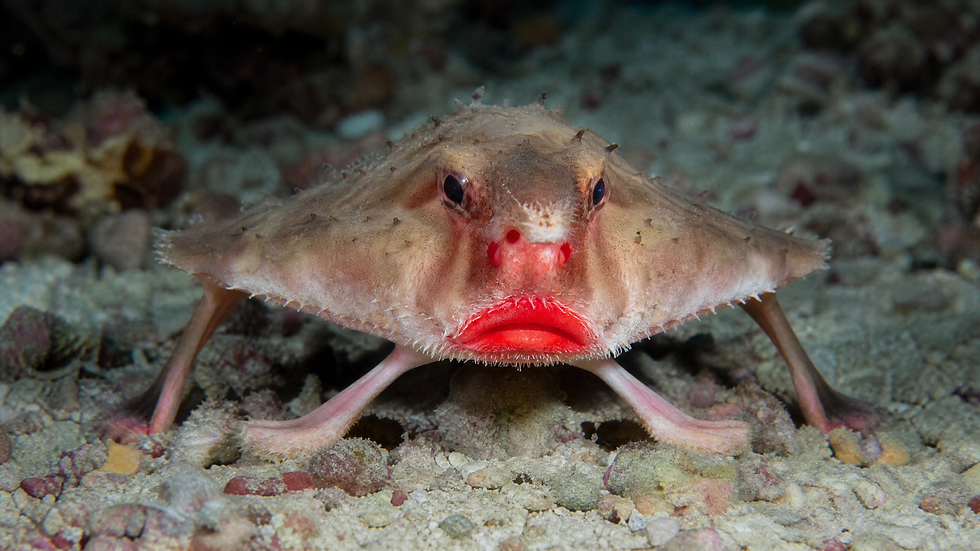
The red-lipped batfish (Halieutichthys acuminatus) lives at depths of 200–2,000 meters in the tropical Atlantic and Pacific oceans. It's small (usually 6 inches or less), and it doesn't swim like most fish. Instead, it walks. Its pectoral fins are modified into leg-like structures, complete with articulated joints that allow it to strut along the ocean floor like it's checking out the local reef scene. Honestly, watching footage of a batfish "walking" is like watching a deep-sea model on a runway.
But here's where it gets even weirder: that red lip coloring? Scientists still don't fully understand its purpose. It could be used to attract mates in the pitch-black depths, or it might be a warning to predators. Some researchers speculate it's a lure—the fish dangles a modified dorsal spine with bioluminescent tips to attract prey, and the red lips might play a role in that hunting strategy. Either way, this little creature has evolved one of the ocean's most unforgettable looks, proving that beauty—or strangeness—is entirely subjective at depth.
Stay Salty
Freediving safety might not sound glamorous, but it's the foundation of every extraordinary dive you'll ever take. The ocean is generous with its beauty—but only to those who approach it with humility and preparation.
Partner up, prepare thoughtfully, respect the water, and trust your training.
The ocean rewards respect with some of the most transcendent experiences available to a human being.


Comments