
Ghost Gear: The Fishing Debris That’s Silently Killing the Ocean (And What Divers Can Do)

You’ve probably seen it on a dive. A tangle of monofilament wrapped around a coral head. A net draped over a reef ledge, swaying in the current like a curtain. A length of rope disappearing into the blue. It looks like trash — because it is. But it’s not passive. It’s still working.
Ghost gear is abandoned, lost, or discarded fishing equipment — nets, lines, traps, and longlines — that continues to catch and kill marine life long after the fishermen who deployed it have moved on. It’s one of the most destructive forms of ocean pollution you almost never hear about. And it’s everywhere.
What Ghost Gear Actually Is
Ghost gear is the term for any fishing equipment that has been lost at sea, abandoned, or deliberately discarded. At least 640,000 tonnes enters our oceans every year, making up approximately 10% of global marine plastic pollution — though in some heavily fished regions the percentage is significantly higher.
It comes in four main forms: gillnets (mesh walls that drift and entangle), longlines (miles of line with hundreds of baited hooks), traps and pots (crab and lobster gear that continues to catch indefinitely when lost), and trawl nets (large dragging nets that can snag on reefs and structures when they break free).
Of the tens of thousands of tons of large plastics accumulated in the north Pacific Ocean’s gyre, between 75 and 86 percent is thought to be fishing nets and ropes. The Great Pacific Garbage Patch — that vast floating mass of ocean debris that makes headlines — is mostly not plastic bottles and bags. It’s mostly fishing gear.
Ghost gear doesn’t drift passively. It fishes. Continuously, indiscriminately, without anyone watching. Fishing nets are specifically engineered to be nearly invisible in water, durable enough to survive storms and currents, and effective at catching almost anything that swims into them. Those properties don’t change when a net is lost. They just become a problem.
The Scale of the Damage
Ghost gear is responsible for harming 66% of marine mammal species, half of seabird species, and all species of sea turtles. Every single sea turtle species. Every one.
An estimated 136,000 whales, dolphins, seals and sea lions die as a result of ghost gear each year. That figure doesn’t include fish, sharks, rays, invertebrates, and the countless other species that are caught, injured, or smothered by ghost gear on reefs and the seafloor.
The killing mechanism is relentless. A gillnet lost at sea fills with catch, sinks under the weight, decomposes enough to release the catch, and then floats back to the surface to fish again. This cycle — called ghost fishing — can repeat for years, sometimes decades. Plastic-based ghost fishing gear can take up to 600 years to decompose. A net lost today will still be fishing when your great-great-grandchildren are alive.
What It Does to Reefs
Beyond entanglement, ghost gear physically destroys reef structure. Nets draped over coral colonies block sunlight, prevent gas exchange, and cause physical abrasion as they move in surge. The weight of accumulated gear can collapse entire reef sections. Traps lost on reef systems sit indefinitely, smothering sessile organisms and altering the bottom habitat.
Reefs that are already thermally stressed from warming oceans are particularly vulnerable. Ghost gear adds a physical, mechanical layer of damage to an ecosystem that’s already fighting to survive.
Why Ghost Gear Keeps Happening
Understanding ghost gear means understanding the fishing industry — not to condemn it, but to see clearly where the problem comes from.
Some gear is lost genuinely accidentally: storms, equipment failures, interactions with other vessels, gear that becomes snagged on underwater structures. A third of fishing lines and 6% of nets are lost to the sea through these kinds of unintentional losses — staggering figures given the scale of global commercial fishing.
Some gear is deliberately abandoned or discarded because retrieval is too expensive, too dangerous, or simply not required by law. In many parts of the world, there is no legal requirement to recover lost gear, no tracking of where gear is deployed, and no financial penalty for abandonment. The economics of fishing create little incentive to retrieve gear that’s already been paid for, especially when it’s lost in deep or remote water.
Illegal, unreported, and unregulated (IUU) fishing — which accounts for a significant portion of global catch — operates entirely outside regulatory frameworks and has no accountability for gear loss at all.
The result is an accumulation problem that’s been building for decades and is only now getting meaningful international attention.
What’s Being Done About It
Global Policy
At the international level, the Global Ghost Gear Initiative (GGGI) is the world’s largest cross-sector alliance working to reduce ghost gear — bringing together NGOs, fishing industry representatives, seafood companies, and governments to develop standards, best practices, and policy frameworks.
The FAO’s voluntary guidelines on the marking of fishing gear (adopted 2019) aim to create a traceable system that connects lost gear to its owner — creating accountability and enabling recovery. Implementation is patchy, but the framework exists.
On-the-Ground Removal
The most direct response is physical retrieval — and this is where divers come in.
Conservation International has developed a ghost gear removal course that has certified nearly 100 divers in Panama, Colombia, Mexico, Peru, Indonesia and Timor-Leste over five years. The course covers underwater signals, how to safely cut, lift and remove ghost gear at depths of up to 18 meters, and the logistics of surface support for larger operations.
One of the program’s biggest victories was removing a net about 300 feet long, which took 17 trained divers working underwater for more than 40 hours, carefully cutting away at ropes.
Ghost Diving Global Mission — a registered charity of volunteer technical divers — specializes in larger, deeper ghost gear removals that recreational divers can’t safely access. Their operations have retrieved thousands of tons of gear from sites across Europe, the Caribbean, and the Indo-Pacific.
Ocean Conservancy is currently running a national program (October 2024 through September 2028) for the removal of large marine debris including derelict fishing gear, with active operations in Alaska and the Lower Florida Keys.
What Divers Can Do
Get Trained in Ghost Gear Removal
Safe ghost gear removal is a skill — not something to improvise. Nets and lines can entangle a diver quickly, and a panicked response in entanglement is one of the most dangerous situations in recreational diving. Getting properly trained before you try to remove anything is essential.
PADI’s Project AWARE runs the Dive Against Debris certification, which includes ghost gear identification and safe reporting. Ghost Diving UK, Ghost Fishing US, and SDI’s Ghost Net Recovery program all offer more advanced training for structured removal operations. Conservation International’s program specifically trains divers in high-impact coastal communities.
The rule: never attempt to remove large nets or complex entanglements alone or without training. Know your limits, brief your buddy, and have a clear abort plan.
Report What You See
You don’t have to remove gear to make a difference. Reporting ghost gear sightings while diving allows professionals to remove the gear and helps develop improved waste management and fisheries management programs. PADI’s Dive Against Debris app lets you log debris sightings with GPS coordinates — data that goes directly into a global database used by researchers and removal teams.
Even a photo with approximate location submitted to a local dive shop, marine park authority, or conservation organization creates an actionable record that someone trained can follow up on.

Small Removals Done Safely
For monofilament line, small tangles of rope, or isolated hooks — the kinds of debris you encounter regularly on recreational dives — safe removal requires only basic equipment: a dive knife or line cutter, situational awareness, and the discipline to stop if the entanglement gets complex.
Cut line at multiple points rather than trying to pull it free in one piece. Keep the removed debris contained — loose monofilament floating back into the water just creates a new hazard somewhere else. Bring a mesh bag on dives at sites known for debris.
Consumer Choices Matter Too
The fishing industry responds to market pressure. Seafood certified by the Marine Stewardship Council (MSC) requires supply chain transparency and gear management practices that reduce loss. Choosing certified seafood creates economic incentive for responsible practices at the source.
Supporting organizations like Ocean Conservancy, WWF’s ghost gear program, and the Global Ghost Gear Initiative with membership or donations funds the policy work and field operations that individual divers can’t accomplish alone.
What You Wear Into the Water Matters Too
There’s one more consideration worth naming: entanglement risk is real for divers in areas with ghost gear, and what you’re wearing affects how easily you can get caught and how quickly you can get free.
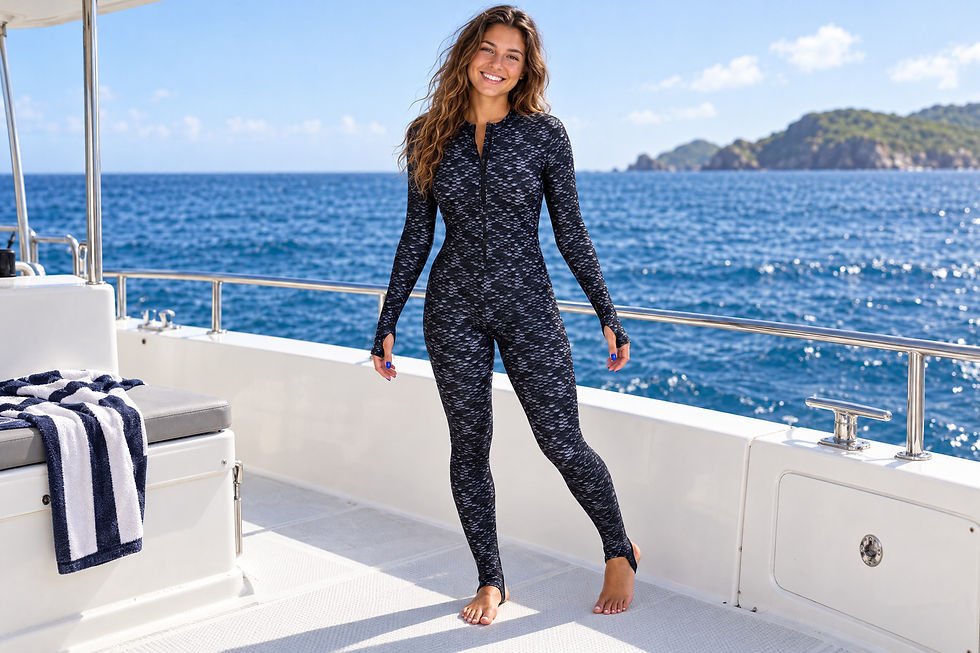
Loose gear, dangling accessories, and billowing cover-ups create snag points. A streamlined, full-coverage dive suit eliminates loose fabric, keeps your profile clean, and reduces the surface area that can catch on a line or net. Plunge’s UPF 50+ Dive Suits are cut for movement and fit close to the body — nothing loose, nothing trailing. Combined with a dive knife as standard equipment on any dive in an area with known debris, you’re as prepared as you can be.
And after a cleanup dive — when you surface tired, wet, and covered in whatever the ocean was hiding — Plunge’s hooded microfiber towels are genuinely useful. Quick-dry, full hood for warming up on deck, large front pocket for small gear, and packable enough to live in your dive bag permanently. The kind of thing you reach for automatically at the end of every dive day.
What the Fish?!
The Cuttlefish: The World’s Most Sophisticated Colorblind Artist

Here’s a fact that should stop you cold: cuttlefish are among the most accomplished color-changers in the animal kingdom, capable of producing thousands of patterns across their skin in fractions of a second. By controlling the 10 million color cells within their skin, they can quickly change color, pattern, and texture — sometimes completing the illusion by making shapes with their tentacles to better blend into the background.
Although renowned for their color-changing ability, these “chameleons of the sea” are colorblind. They have a single type of photoreceptor in their eyes. They cannot distinguish red from green from blue. And yet they produce camouflage that matches their background in both pattern and color so precisely that they fool the color-vision predators hunting them.
How? Scientists are still working it out. One leading hypothesis involves chromatic aberration — the tendency of lenses to focus different wavelengths of light at slightly different distances. By rapidly adjusting the focus of their distinctive W-shaped pupils, cuttlefish may be able to derive color information from when objects blur in and out, rather than from color receptors directly. It’s a completely alien way of perceiving the world that has no equivalent in vertebrate biology.
The skin itself is a three-layer system: chromatophores (pigment cells that expand and contract under muscular control), iridophores (structural cells that reflect specific wavelengths like biological mirrors), and leucophores (cells that scatter all light). Operating these three layers simultaneously, at the speed they do, requires a level of neural processing that researchers are still trying to fully map.
Beyond camouflage, cuttlefish are genuinely intelligent. They have a large brain-to-body size ratio among the biggest of all invertebrates, pass delayed gratification tests, recognize individual humans, use deceptive tactics during hunting, and have been observed playing — manipulating objects with no apparent purpose beyond exploration. They have a lifespan of only one to two years, meaning everything they learn is self-taught, from scratch, in less time than most vertebrates spend as juveniles.
They also have W-shaped pupils that allow them to see almost entirely behind them simultaneously — a visual field so wide it’s closer to all-around than directional. A cuttlefish hovering on a reef is watching more of the world at once than you can, with a brain that’s doing things with that information we still don’t fully understand.
Stay Salty
Ghost gear is a problem that divers didn’t create but are uniquely positioned to address. Get trained, report what you see, make small removals safely, and spend your dollars on seafood that comes from fisheries that take gear management seriously. The reef you’re diving next week may already have ghost gear on it. The one you’re diving in five years might not — if enough people who love the ocean decide to do something about it.


Comments