
How to Choose Reef-Safe Sunscreen — And Why It Matters More Than You Think
You slather on sunscreen, jump in the ocean, and feel good about protecting your skin. But here's the uncomfortable truth: some of what you just applied is now dissolving into the water around the reef you came to see.
Sunscreen and coral reefs have a complicated relationship. And if you spend real time in the ocean — snorkeling, freediving, scuba diving, paddling — it's worth understanding what's actually in your bottle, what reef-safe sunscreen is, and what it does once it hits the water.

Why Sunscreen Is a Reef Problem
Coral reefs are already under enormous pressure — warming oceans, acidification, runoff, and overfishing. Sunscreen chemicals add to that load in ways researchers are still fully mapping, but the picture is clear enough to act on.
An estimated 14,000 tons of sunscreen enters the ocean every year. Studies have shown that certain chemical UV filters — particularly oxybenzone and octinoxate — can disrupt coral's reproductive cycles, damage its DNA, increase bleaching susceptibility, and deform developing coral larvae even at very low concentrations.
Hawaii was the first US state to ban oxybenzone and octinoxate in sunscreens sold there, effective 2021. The US Virgin Islands, Palau, Bonaire, and parts of Mexico's coral reef zones followed. These aren't fringe policies — they're responses to real science.

What "Reef-Safe Sunscreen" Actually Means (And What It Doesn't)
Here's where it gets tricky. "Reef-safe" is not a regulated term. Any brand can print it on a label without meeting any defined standard. So seeing those words on the bottle means almost nothing on its own.
What actually matters is the ingredient list.
Ingredients to Avoid
These are the chemical UV filters most commonly flagged for coral harm:
Oxybenzone — the most studied and most harmful. Banned in several coral-protected regions.
Octinoxate — also banned in Hawaii and parts of the Caribbean.
Octocrylene — breaks down into benzophenone in the environment; increasingly flagged by researchers.
Homosalate, octisalate, avobenzone — less studied but increasingly under scrutiny. Some researchers recommend avoiding these too when diving on reefs.
What to Look For Instead
Mineral sunscreens use physical UV blockers rather than chemical ones:
Zinc oxide — the gold standard. Broad-spectrum, stable, and the least harmful to marine environments of any UV blocker currently available.
Titanium dioxide — also a physical blocker, though zinc oxide is generally preferred for both efficacy and environmental profile.
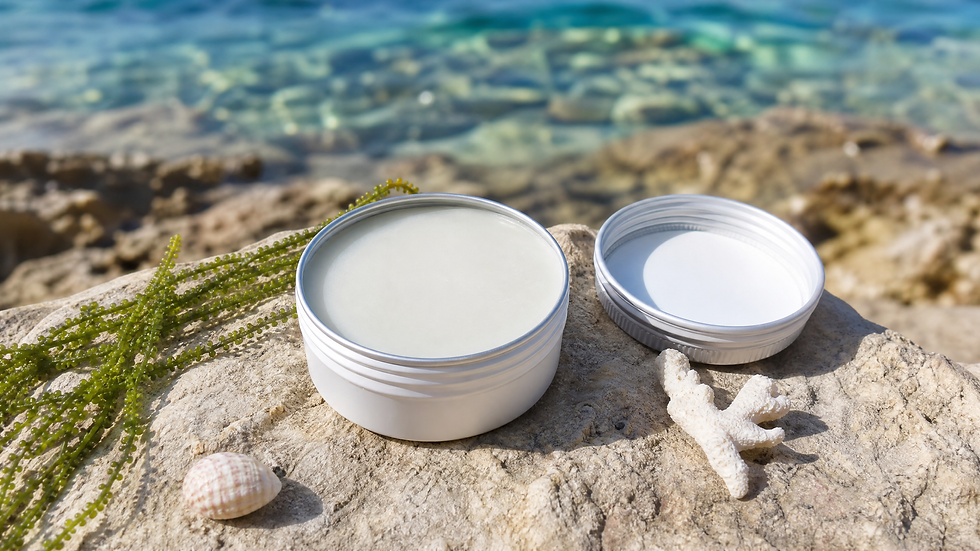
The catch: mineral sunscreens tend to be thicker, can leave a white cast, and don't always play well with water sports. Which brings us to the real solution.
The Problem With Any Sunscreen in the Ocean
Even the best mineral sunscreen has a fundamental flaw for divers and snorkelers: it comes off. Every entry, every surface interval, every hour in the water washes it away — and into the ecosystem around you.
The American Academy of Dermatology recommends reapplying sunscreen every two hours, or immediately after swimming. If you're doing multiple dives, that's a lot of product going directly into the water. Even mineral formulas aren't entirely benign in high concentrations — nanoparticle zinc oxide has its own ongoing research questions.
For anyone spending serious time in the ocean, the most effective and environmentally responsible approach is to cover up first and use sunscreen only on exposed areas.
Full-Body Coverage: The Better Answer
A UPF 50+ dive suit blocks 98% of UV rays — no reapplication, no runoff, no reef impact. It works on your first dive and your fourth. It doesn't sweat off during surface intervals or wash away on entry.

Plunge's UPF 50+ Dive Suits were built for exactly this situation. Full-body coverage that moves with you whether you're freediving, snorkeling, or floating between dives.
Paired with a UPF headband to protect your scalp and face, you dramatically reduce the amount of sunscreen you need to apply in the first place — which means less chemical load on the reefs you're there to see.
It's a better system all around. Better for your skin, better for the water, and honestly better for your morning routine when you're gearing up for a dive day.
Practical Tips for Sun-Safe, Reef-Conscious Diving
Apply sunscreen at least 15 minutes before entering the water. This lets it bind to your skin rather than immediately washing off into the ocean.
Use sunscreen only where your suit doesn't cover. Face, back of hands, neck — the areas genuinely exposed. Everything else? Let the suit handle it.
Choose non-nano zinc oxide when possible. Non-nano particles are too large to be absorbed by coral cells, making them a safer choice than nano-formulations.
Avoid spray sunscreens near the water. They drift, miss their target, and land directly in the ocean. Lotions and sticks are far more controlled.
Check the destination's rules before you go. If you're diving in Hawaii, the Virgin Islands, Palau, or Mexico's reef zones, chemical sunscreens may be banned outright. Arrive prepared.
Store sunscreen out of direct heat. UV filters degrade in high temperatures, reducing effectiveness before you even apply it.
Does "Biodegradable" Mean Reef-Safe?
Not necessarily. Biodegradable means the ingredients break down over time — but they can still cause harm before they do. It's a marketing term, not a safety certification. Check the ingredients, not the label claims.
Same goes for "ocean-safe," "eco-friendly," and "natural." None of these have regulatory definitions in the sunscreen space. Ingredient transparency is the only reliable metric.
What the Fish?!
The Giant Oarfish: The Sea Serpent Was Real All Along
If you've ever seen something long, silver, and impossibly large moving through the water and thought your eyes were playing tricks — they probably weren't. The giant oarfish (Regalecus glesne) is the longest bony fish on the planet, reaching confirmed lengths of 26 feet and almost certainly growing longer in the deep ocean where we rarely see them. Some historical accounts describe specimens over 50 feet. The legends of sea serpents? Almost certainly oarfish.

They live in the mesopelagic zone — roughly 650 to 3,000 feet down — which is why most people never encounter one. When they do appear near the surface or wash ashore, it's almost always because the fish is sick, dying, or has been driven up by deep currents. Which means live sightings by divers are extraordinarily rare and genuinely unforgettable.
An oarfish moves by undulating its long dorsal fin — a continuous rippling ribbon that runs the entire length of its body — while holding itself vertically in the water column. Upright. Like a curtain. Divers who have encountered them describe the experience as otherworldly: this enormous, shimmering silver ribbon just hanging in the blue, watching you back with huge, glassy eyes.
They have no teeth and no real defenses. They eat small crustaceans and squid. They are, despite every physical impression they make, completely harmless. Just ancient, enormous, and deeply strange — which is honestly the best combination the ocean offers.
Stay Salty
The reef doesn't ask much of us. Read your labels, cover up where you can, and leave the water a little cleaner than you found it. That's the whole deal.


Comments