
How to Help Sharks: What Divers Can Actually Do (Beyond Not Panicking)
Updated: Aug 18
You've learned how to stay calm when a shark appears on your dive. You know to hover, face it, and resist every instinct to bolt for the surface. That's step one.
But here's the thing about loving sharks: staying calm in the water is the floor, not the ceiling. If you want to know how to help sharks in a meaningful way, the answer starts on the surface — with how you spend your time, your money, and your voice. The ocean's most important predators are in serious trouble, and divers — people who've seen sharks up close, who understand their grace, who know firsthand that the fear is wildly overblown — are some of the most powerful advocates they have.
Here's how to actually help.

How to Help Sharks: Start With What You're Eating
Sustainable seafood choices are one of the most direct things any ocean-lover can do — not just for sharks, but for the broader ecosystem sharks depend on.
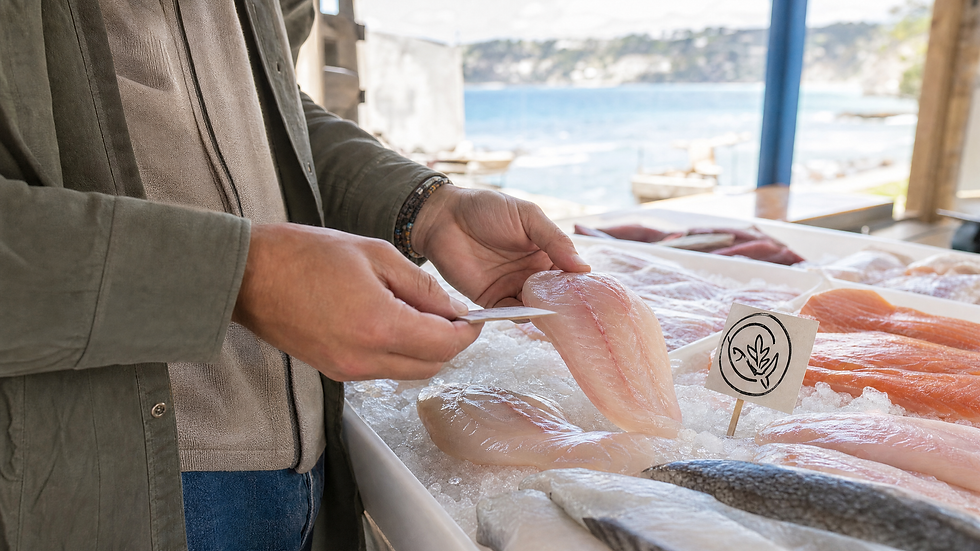
Bycatch is a massive problem. Longlines set for tuna and swordfish catch and kill enormous numbers of sharks that were never the target. Choosing seafood certified by the Marine Stewardship Council (MSC) or using the Monterey Bay Aquarium's Seafood Watch app gives you a real-time guide to which fisheries operate with lower bycatch rates.
And check your labels. Shark is sold under dozens of names — flake, rock salmon, huss, dogfish, and others — that obscure what you're actually buying. If you're in a fish and chip shop in the UK or Australia and ordering "flake," there's a reasonable chance you're eating shark. Knowing the aliases matters.
Understand What's Actually Threatening Them
Before we talk about solutions, it helps to understand the scale of the problem. Sharks have survived for 450 million years. In the last 50, human activity has driven shark and ray populations down by more than 70 percent. Over 73 million sharks are killed and traded annually, and three-quarters of oceanic shark and ray species are now threatened with extinction.
The main threats are overfishing, bycatch, habitat destruction, and the shark fin trade. Climate change compounds all of it by degrading the reef ecosystems sharks depend on.
The good news: every single one of these threats is driven by human behavior. Which means human behavior can change them.
Support the Shark Fin Trade Bans — And Know Where They Stand
The shark fin trade has been one of the most significant drivers of shark population collapse worldwide. Shark fins are served almost exclusively in shark fin soup, considered a symbol of prosperity and hospitality — yet the fins themselves are virtually tasteless, and fishermen trying to conserve space on their boats discard the mutilated animals overboard after slicing off their fins.
Progress is being made. In December 2022, the Shark Fin Sales Elimination Act was signed into law, prohibiting the sale, purchase, possession, and transport of shark fins and shark fin products in the US. The UK passed the Shark Fins Act in 2023, banning the import and export of shark fins.
These are meaningful wins. But legislation only works with enforcement, and enforcement requires public pressure. Follow organizations like the Shark Conservation Fund and Humane World for Animals, sign petitions when new protections come up for vote, and share accurate information about the fin trade when the topic comes up. Changing the cultural narrative around shark fin soup — particularly in communities where demand is highest — is a long game, and visibility matters.
Participate in Citizen Science
The Easiest Way to Help Sharks: Log What You See
This one is genuinely exciting, especially for divers. Your time in the water isn't just recreational — it's data.
PADI AWARE has launched the Global Shark & Ray Census, the largest underwater citizen science program designed to protect sharks and rays from extinction. Divers log their shark sightings through a standardized protocol, contributing to a growing global dataset that researchers use to track population trends, migration patterns, and habitat use. Every sighting counts, including the ones that seem unremarkable.
NOAA's Cooperative Shark Tagging Program, initiated in 1962, is one of the oldest citizen science programs in NOAA Fisheries — a collaborative effort between recreational anglers and NOAA to learn more about the life history of Atlantic sharks. To date, over 300,000 sharks have been tagged and almost 20,000 have been recaptured. Anyone can volunteer to be a tagger.
For divers who want to go deeper, researchers from the MigraMar consortium take volunteer divers on citizen science expeditions to tag and track pelagic sharks as they migrate through the Eastern Pacific — using data to advocate for expanded marine protected areas. The University of Miami's Shark Research & Conservation Program also runs public citizen science tagging trips that anyone can join.
If you're logging dives anyway, you may as well make those dives count for something.

Choose Your Dive Operators Carefully
Where you spend your dive dollars matters. Shark diving is a significant industry, and responsible shark diving operations are some of the strongest economic arguments for keeping sharks alive and in the water.
A live shark in a healthy reef ecosystem generates far more revenue over its lifetime through dive tourism than it ever would on a fishing boat. Studies in places like the Maldives and Palau have quantified this directly — a single reef shark can be worth hundreds of thousands of dollars in tourism revenue over its lifetime. That argument lands with governments and fishing communities in ways that pure conservation messaging often doesn't.
Look for operators who follow established shark diving guidelines: no feeding that conditions sharks to associate humans with food, no touching, maintaining respectful distances, and briefing divers on proper behavior before entering the water. Blue Star-certified operators in the Florida Keys are a good benchmark for responsible practices closer to home.
Avoid operators who use bait in ways that are clearly about spectacle rather than the animals' wellbeing, or who allow or encourage touching, riding, or harassing sharks for photos.

Advocate Loudly and Accurately
The most persistent obstacle to shark conservation is fear. When people are afraid of something, they don't protect it — they allow it to be eliminated. Shifting the public narrative around sharks is unglamorous work, but it matters enormously.
As a diver, you have something most people don't: direct experience. You've been in the water with sharks. You know what an encounter actually looks like. That firsthand credibility carries weight in conversations that statistics alone don't move. Knowing how to help sharks isn't just about what happens underwater — it's about what you say when you come back up.
Push back gently but consistently when you see sensationalized shark attack coverage. Share the actual numbers — sharks kill fewer than 10 people annually worldwide, while humans kill tens of millions of sharks every year. Context collapses the fear.
Support organizations doing the science and the policy work: the Shark Conservation Fund, Shark Stewards, PADI AWARE, and the Marine Megafauna Foundation all have transparent, impact-focused programs worth backing.
Protect Their Habitat
Sharks don't exist in isolation. They need healthy reefs, clean water, and intact food webs. Everything that threatens coral reefs threatens sharks too.
This means the reef-safe sunscreen conversation matters for sharks. It means reducing single-use plastic. It means supporting marine protected areas even when they create fishing restrictions. Sharks are the apex of a system — protect the system, and you protect them.
If you dive regularly, consider getting involved in reef monitoring or debris removal programs at your local sites. The data collected by volunteer divers directly informs the management decisions that determine whether marine protected areas are expanded, maintained, or weakened.
Gear Up Like You Mean It
There's one more way to show up for the ocean every time you dive: choose gear that's built for full days on the water, not just the 45 minutes you're actually underwater.

Surface intervals, boat rides, long mornings waiting for the right conditions — that's when sun exposure stacks up and when most divers are least protected. A Plunge UPF 50+ Dive Suit gives you full-body coverage that doesn't wash off, doesn't need reapplying, and keeps reef-damaging sunscreen chemicals out of the water you're working so hard to protect. It's a small, easy choice that lines up with everything else on this list.
If you're going to advocate for healthy oceans, it helps to show up dressed like someone who means it.
The Diver's Advantage
Here's the thing that conservation organizations understand but don't always say clearly enough: divers are a disproportionately powerful force for ocean advocacy. You're already out there. You already care. You've already seen what's worth protecting.
That's not nothing — that's actually everything. The most effective conservation happens when the people who've witnessed something beautiful decide they're not going to let it disappear quietly.
Sharks have been on this planet for 450 million years. They've outlasted five mass extinction events. The one thing they haven't evolved a defense against is us — and the best thing we can do is become their defense instead.
What the Fish?!
The Tasselled Wobbegong: The Shark That Looks Like a Carpet (And Hunts Like a Trap)

wobbegong is a shark. That sentence alone tends to surprise people, because nothing about a wobbegong looks like what we've been trained to picture when we hear the word "shark."
The tasselled wobbegong (Eucrossorhinus dasypogon) is a bottom-dwelling carpet shark found in the shallow coral reefs of northern Australia, New Guinea, and the surrounding Indo-Pacific. It grows to about 1.8 meters and spends the vast majority of its life doing something most sharks would find unthinkable: lying completely still on the seafloor, camouflaged to the point of near-invisibility.
Its body is flattened, covered in an intricate pattern of brown, cream, and tan that mirrors reef rubble almost perfectly. Around its head runs a fringe of elaborate branched lobes — the "tassels" — that break up its outline and look indistinguishable from algae or coral growth. Prey items swim directly over it, and often directly into it, without ever registering that there's a predator there at all.
When something edible gets close enough, the wobbegong opens its enormous mouth — disproportionately large for its body — and engulfs it in a strike fast enough that high-speed cameras have had trouble fully capturing it. It doesn't chase. It doesn't patrol. It simply waits, with extraordinary patience, and lets the ocean deliver lunch.
Wobbegongs are not aggressive toward divers, but they have bitten people who accidentally stepped on or grabbed them — which, given how well they disappear into the reef, is an entirely understandable mistake. Look carefully! That gorgeous patch of encrusted rubble might be watching you back.
Stay Salty
Sharks have been here for 450 million years. With a little help from the people who love the ocean most, they'll be here for a lot longer. Get in the water, log your sightings, spend your dive dollars wisely, and talk about what you've seen. The sharks can't advocate for themselves. That part's on us.


Comments