
Scuba Diving for Beginners: Everything You Need to Know Before You Take the Plunge
You've been watching dive videos for months. You've snorkeled, maybe tried a shallow freedive, and every time you see a scuba diver glide past you underwater — weightless, hovering above a coral wall with zero apparent effort — you think: I want to do that. Good news: you absolutely can. Scuba diving for beginners is far more accessible than most people imagine, and the learning curve, while real, is one of the most rewarding things you'll ever climb. This guide is for anyone who's curious, a little nervous, or just ready to stop watching and start doing.

What Is Scuba Diving for Beginners, Really?
Scuba stands for Self-Contained Underwater Breathing Apparatus — meaning you carry your own air supply on your back, giving you total freedom to explore the underwater world without surfacing to breathe. Unlike freediving, where every second underwater is a race against your breath-hold, scuba lets you slow down, hover, and really look at things. A sea turtle napping on the reef. A moray eel watching you from its crevice. The way light fractures at depth into moving, wavering lines. Scuba diving is the closest most of us will ever get to genuinely flying.
Getting Your Scuba Certification: The Open Water Course
Before you can rent a tank and explore independently, you'll need an Open Water certification — the entry-level scuba qualification recognized worldwide. The gold standard is PADI (Professional Association of Diving Instructors), though SSI, NAUI, and RAID are equally respected. The Open Water course typically involves three components: theory (you can now complete this online through eLearning, at your own pace), confined water sessions where you practice skills in a pool, and four open water dives in the ocean to demonstrate what you've learned.

The whole thing typically takes three to four days if you do it on location during a dive trip, or a few weekends if you train at a local dive shop first. The minimum age is 10 for the PADI Junior Open Water Diver certification, and 15 for the full adult certification. Once certified, your card doesn't expire — you're a diver for life.
What to Expect on Your First Scuba Diving for Beginners Dives
Your first confined water session will feel strange. You'll be kneeling on the bottom of a pool, breathing through a regulator, convincing your brain that yes, you really can breathe underwater. It feels counterintuitive for about 30 seconds.
Then it clicks, and you realize: this is remarkable. Your instructor will take you through fundamental skills: clearing water from your mask, recovering your regulator if it's knocked out of your mouth, ascending and descending in a controlled way. None of it is scary when done step by step with a good instructor. Most beginners are surprised by how calm they feel once they're underwater.
The open water dives happen in the actual ocean — and this is where everything changes.
Even a shallow reef at 6 to 12 metres looks like another universe when you're weightless in it, moving slowly, surrounded by fish that have absolutely no interest in leaving on your account. Your first scuba diving experience in open water is one of those things you'll remember for the rest of your life.

The Gear: What You'll Be Wearing and Why
During your course, your dive shop will provide all the gear you need. As a beginner, here's a breakdown of the core pieces:
The BCD (Buoyancy Control Device) is your inflatable jacket — you add air to ascend and release air to descend, using it to achieve neutral buoyancy at depth. Getting your buoyancy right is the holy grail of early scuba diving; once you nail it, you'll feel like you're floating in space.

The regulator is what you breathe through — it reduces the high-pressure air in your tank to a pressure you can actually inhale. The computer (dive computer) is your wrist-mounted device that tracks your depth, time, and ascent rate to keep you safe. The tank is the cylinder of compressed air on your back — typically giving a recreational diver 40 to 60 minutes of bottom time at 18 metres. And fins, mask, and wetsuit complete the picture: you'll typically wear a 3mm wetsuit in warm tropical water, thicker in colder conditions.
The Secret to Great Scuba Diving: Buoyancy, Breathing, and Going Slow
Here is the thing experienced divers will tell you that instructors sometimes forget to emphasize: the skill that separates a good diver from a great one isn't any particular technique. It's buoyancy. Perfect buoyancy means you hover in the water column without sinking or floating, using only tiny adjustments to your breathing. Breathe in slightly — you rise. Breathe out — you sink. When you get this right, you stop fighting the water entirely. You become part of it.
Equally important: go slow. The divers who see the most are rarely the fastest. Slow down, lower your kick frequency, and let the reef come to you. A hovering diver who is patient will share a two-minute moment with a curious octopus that blows straight past the diver who is in a hurry. There is no rush down here. The reef has been here for thousands of years. You've got 45 minutes of air. Make them count.
Scuba Diving Safety Essentials Every Beginner Must Know
Scuba diving is statistically very safe when done correctly — far safer than driving a car, to use the frequently-cited comparison. But there are non-negotiable rules that protect you. Never hold your breath underwater. This is the cardinal rule of scuba: if you hold your breath and ascend, the air in your lungs expands as pressure decreases. The results can be catastrophic. Always breathe continuously, even in very shallow water. Always ascend slowly — the standard rate is no faster than 9 metres per minute — and always do a safety stop at 5 metres for 3 minutes on dives below 10 metres. Never dive alone; always have a buddy or a guide. And always respect your limits. If something doesn't feel right on a dive, it is completely acceptable to signal your buddy, ascend, and call it. The ocean will be there tomorrow.
What to Wear: Protecting Your Skin on a Dive Day
Here's something nobody puts in their beginner scuba guide: a full day of scuba diving involves a lot of time in the sun. Boat rides between sites. Surface intervals floating on your back. Waiting on the dive deck while your buddy gears up. That tropical sun is relentless, and it adds up fast.
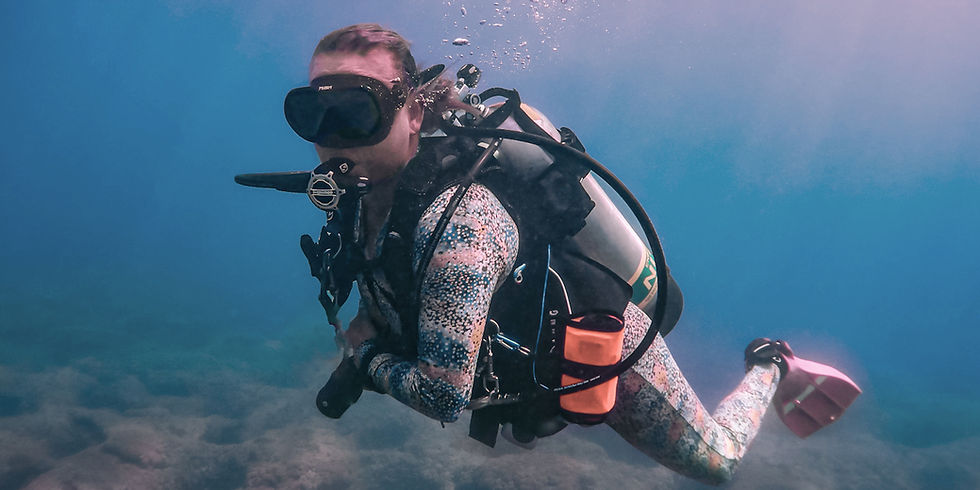
A UPF 50+ dive suit from Plunge Waterwear solves this quietly and completely. Instead of reapplying sunscreen on a moving boat (always fun) and still ending up with sunburned shoulders and missed patches, you're covered the moment you put it on.
Our suits block 98% of UV radiation, move with your body in the water, and are light enough to wear comfortably between dives without overheating on deck. For new divers especially — who often spend more time at the surface as they get comfortable with their equipment — that continuous sun protection makes a real difference.
You end your day actually comfortable, not crispy.

What the Fish?!
Meet the Flamboyant Cuttlefish: Nature's Most Dazzling Drama Queen
Most cuttlefish are masters of camouflage — but the flamboyant cuttlefish (Metasepia pfefferi) didn't get the memo.

While its relatives are busy being invisible, this tiny cephalopod does the exact opposite: it pulses with rolling waves of yellow, white, brown, and magenta in a hypnotic, shifting display that looks less like an animal and more like a living lava lamp. Found in the shallow tropical waters of the Indo-Pacific — Indonesia, the Philippines, Papua New Guinea, and northern Australia — the flamboyant cuttlefish is one of the most sought-after sightings in muck diving. It reaches just 8 centimetres in length, but its personality takes up the whole ocean.

Here's the plot twist: those dazzling colours aren't just for show. They're a warning. The flamboyant cuttlefish is one of only three cephalopods known to be toxic. Its muscles contain a compound that is highly poisonous if eaten — and its flashing colours are an honest signal to predators: I am not a snack.
Unlike most cuttlefish, it often walks along the seafloor on its arms and two fin-flaps rather than swimming, giving it the distinct energy of a tiny, extremely confident creature who knows exactly what it is.
Spot one and you'll understand why divers travel across the world for muck diving. They are, without question, ridiculous. In the best possible way.
Ready to Take the Plunge?
Scuba diving for beginners is one of those rare experiences that genuinely lives up to the hype. The ocean looks different from inside it — more alive, more layered, more extraordinary than any description from the surface can capture. You don't need to be a strong swimmer or a born adventurer. You need curiosity, a willingness to learn, and the patience to breathe slowly and look carefully.
Find a good instructor. Book the course. Do the pool work seriously. And then, when your instructor gives the signal and you drop below the surface on your first open water dive — breathe. Just breathe. The rest takes care of itself.
Until next time — Stay Salty!
~ The Plunge Waterwear Team


Comments