
Coral Reef Bleaching: What's Really Happening Beneath the Surface (And What Divers Can Do About It)
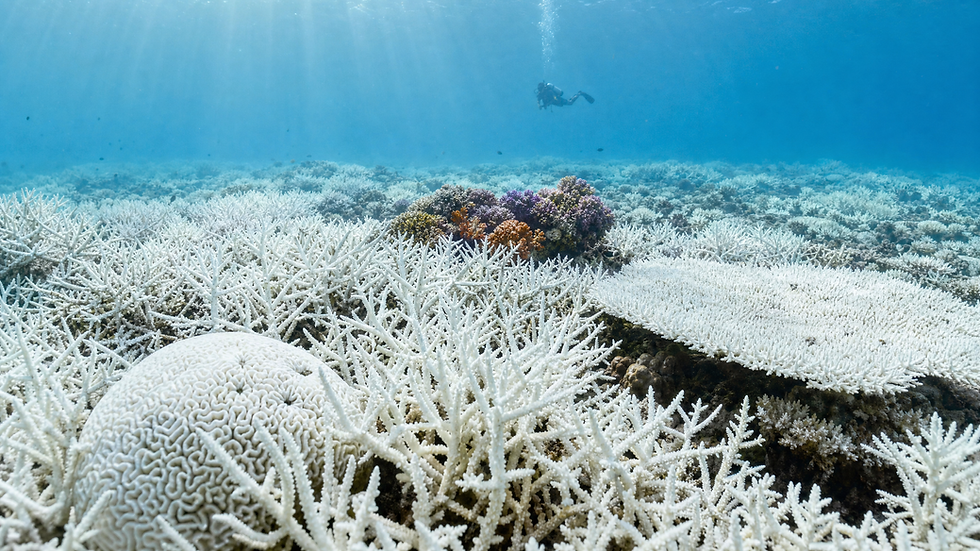
You've seen the photos. Bleached white coral stretching as far as a diver's eyes can see — where there was once a riot of color, now just pale, ghostly skeletons reaching toward the surface. If you've been diving or snorkeling for any length of time, coral reef bleaching is something you've probably heard about, maybe even witnessed firsthand. But what is actually happening when a reef bleaches? Why is it happening more often? And — crucially — is there anything the ocean community, divers like us, can genuinely do about it? This one matters.
What Is Coral Reef Bleaching, Actually?

Coral is not a rock or a plant — it's an animal. Specifically, it's a tiny colonial animal called a polyp, and each polyp lives in a symbiotic relationship with microscopic algae called zooxanthellae. These algae live inside the coral's tissue and are, in a very real sense, the coral's life support system. They photosynthesize sunlight and provide the coral with up to 90% of its energy, while also giving reefs their vivid, extraordinary color. When coral becomes stressed — primarily from water that is too warm, but also from pollution, disease, or acidification — it expels these algae. Without them, the coral turns white.
That's bleaching. The coral isn't dead yet, but it's in serious trouble. A bleached reef is a stressed reef, running on empty, vulnerable to disease, and unable to grow. If the stress passes quickly enough, the algae can return and the coral can recover. But if temperatures stay elevated for weeks or months — which they increasingly do — the coral starves. It dies. And what took decades to build can be lost in a single summer.
The Scale of the Problem: Why Coral Reef Bleaching Is Getting Worse

Here's the hard truth: coral reef bleaching events used to be rare. The first global-scale bleaching event was recorded in 1998, tied to a severe El Nino and elevated ocean temperatures. It was devastating — and it was considered a wake-up call. Then came 2010. Then 2016, which triggered a mass bleaching event on Australia's Great Barrier Reef so severe that scientists described it as the worst coral bleaching event in recorded history at the time. Then 2017. Then 2020. In 2024, scientists confirmed another global mass coral bleaching event — the fourth on record and, by some measures, the most extensive ever documented, affecting reefs across every major ocean basin simultaneously.
The trend is stark. What was once a once-in-a-decade catastrophe is now occurring so frequently that reefs don't have time to recover between events. A reef that might have taken 10 to 15 years to bounce back from a bleaching event is now being hit again before recovery is anywhere near complete. And the driver, across all of these events, is the same: elevated ocean temperatures caused by climate change. The ocean absorbs roughly 90% of the excess heat trapped by greenhouse gas emissions. That warming has real, measurable, catastrophic consequences — and nowhere are they more visible than on a bleached reef.
Coral Reef Bleaching and What It Means for the Ocean's Future
Coral reefs cover less than 1% of the ocean floor — yet they support an estimated 25% of all marine species. They protect coastlines from storm surge and erosion. They support hundreds of millions of people who rely on reef-based fisheries for food and income. They generate billions of dollars annually in tourism. When reefs die, entire ecosystems collapse. Fish populations crash.
Coastal communities lose their buffer against extreme weather. The biodiversity that makes a reef like Raja Ampat or the Great Barrier Reef one of the most extraordinary places on the planet simply stops existing. This is not hypothetical. It is already happening, in reefs that were thriving twenty years ago and are now pale rubble fields.
What Divers Can Actually Do (And It's More Than You Think)

Here's something that doesn't get said enough: divers and ocean lovers are not helpless here. The causes of coral reef bleaching are global and systemic — yes. But the response doesn't have to be. There is a meaningful, practical role for every person who spends time in or near the ocean, and it goes well beyond "don't touch the coral" (although that absolutely still applies).
Become a Citizen Scientist
Apps like CoralWatch, Reef Check, and CORIS allow divers to record and report what they're seeing on reefs worldwide — bleached areas, recovering areas, species counts. This data is used by researchers and conservation organizations tracking bleaching events in real time. If you're diving on a reef and you see bleaching, documenting it contributes to a global picture that individual research teams could never build alone. You don't need a science degree. You need a mask, a dive buddy, and a willingness to pay attention. Every report matters.
Make Reef-Safe Choices
Chemical sunscreens — particularly those containing oxybenzone and octinoxate — have been shown in research studies to cause coral bleaching, DNA damage in juvenile corals, and deformities in larval fish even at very low concentrations. Hawaii, Palau, and several other dive destinations have banned these chemicals outright. If you're wearing sunscreen in the ocean, make it a reef-safe mineral formula (zinc oxide or titanium dioxide) or, better yet, cover up with a UPF dive suit and reduce your reliance on sunscreen altogether. What's good for the reef is also good for you — and it's genuinely one of the easiest swaps you can make.
Support Reef Restoration and Conservation Organizations
Organisations like SECORE International, the Coral Restoration Foundation, and CORAL (the Coral Reef Alliance) are doing critical, ground-level work: growing resilient coral fragments on nurseries, replanting bleaching-resistant strains, advocating for marine protected areas, and funding research into assisted evolution of corals that can survive warmer water. Supporting them — financially, through volunteer programs, or simply by amplifying their work — makes a tangible difference.
Many dive operators in high-reef areas also run reef-restoration programs you can participate in directly. Ask your dive shop or liveaboard operator what they're involved in. The best dive companies in bleaching-affected regions are already part of the solution. Choose them when you travel.
Protect Yourself While You Protect the Reef

Here's something that rarely gets talked about in the context of reef protection: the sun exposure you accumulate on a typical dive day is significant — and most of it isn't happening underwater. It's happening on the boat, in surface intervals, in the water between dives, floating on your back during a breathe-up. The reef you're trying to protect is just below you. And your sunscreen is washing off into it with every splash. Plunge Waterwear's UPF 50+ Dive Suits were designed for exactly this — for people who spend real, extended time in and around the water, and want protection that doesn't compromise anything.
They block 98% of UV radiation, move freely in the water (so they never fight your body on a descent or surface swim), and eliminate the need for chemical sunscreen on the parts of your skin they cover. For a diver who cares about reef health — and we're guessing that's you — switching to a full-coverage UPF dive suit isn't just a smart choice for your skin. It's one small, practical thing you can do every single time you enter the water to make sure you're not part of the problem. The reef doesn't need your sunscreen washing into it. It needs your passion, your presence, and your protection.
What the Fish?!
Meet the Bobbit Worm: The Ocean's Most Terrifying Ambush Predator

You probably haven't seen one — and if you have, you may not have known what you were looking at. The Bobbit Worm (Eunice aphroditois) spends most of its life buried beneath the seafloor, with only its jaws and the first few centimetres of its body breaking the surface of the sand. But what a body it is. These creatures can grow to over three metres in length — some specimens have been recorded at closer to five — making them one of the largest polychaete worms on the planet. And they are absolutely, methodically, built to kill.
The ambush strategy is deceptively simple. The worm anchors itself vertically in a burrow — sometimes several metres deep — and waits, motionless, for prey to pass overhead. When something triggers its sensors, it strikes with explosive speed, seizing fish, crustaceans, and even small octopuses with its scissor-like, chitinous jaws. The strike is powerful enough to slice prey clean in half. In some documented cases, fish have been found on the seafloor near coral reef systems with injuries consistent with a strike so forceful it severed their midsection in a single motion. The worm then drags its prey underground before anything — or anyone — knows it was ever there.
They're found in tropical and subtropical waters across the Indo-Pacific, the Atlantic, and throughout the reef systems of Southeast Asia — which means if you've been night diving in Indonesia, the Philippines, or the Caribbean, there's a reasonable chance one was within metres of you. They're not considered dangerous to humans under normal circumstances, but their jaws can cause serious lacerations, and aquarium owners who've accidentally discovered one living undetected in their live rock (sometimes for months, quietly eating their fish) have a very specific kind of story to tell. Keep your eyes on the sand. The ocean floor is not as still as it looks.
The Reef Is Worth Fighting For
Coral reef bleaching is the most visible symptom of a warming ocean — and the ocean doesn't have the luxury of time. But divers, snorkelers, and ocean lovers are uniquely positioned in this story. You've been in the water. You know what a living reef looks like and what a bleached one feels like. You have a visceral, personal connection to what is being lost — and that matters, both for motivating action and for inspiring others.
Show up for these reefs. Document what you see. Choose reef-safe. Support restoration. Cut chemical sunscreen out of your ocean kit. Talk about coral reef bleaching to people who haven't seen a reef and don't yet understand what's at stake. And come back to the water, over and over — because reefs need advocates who love them enough to keep showing up, bearing witness, and refusing to look away.
The ocean gave you some of your best experiences. It's asking for something back. Let's go.
Until next time — Stay Salty!
~ The Plunge Waterwear Team


Comments