
Freediving Breathing Techniques: How to Dive Deeper, Stay Calmer, and Actually Enjoy the Descent
- Plunge Waterwear
- Apr 29
- 7 min read

Take a full breath. Hold it. Now imagine dropping below the surface, watching the light above you bend and ripple, feeling the water's pressure begin to wrap around you as you slide deeper — quieter, calmer, more weightless with every metre. That's the promise of freediving. And the thing standing between most beginner freedivers and that feeling? Not fitness. Not gear. Not even fear. It's breath.
Specifically, it's not yet knowing how to use it. Freediving breathing techniques are the foundation of everything in this sport — they determine how long you can stay down, how relaxed you feel at depth, and whether the descent feels like a fight or a flow.
Get them right, and the ocean opens up in ways you never expected.
Why Freediving Breathing Techniques Are the Whole Game
Here's something that surprises a lot of people new to the sport: the urge to breathe during a freedive isn't triggered by running out of oxygen. It's triggered by carbon dioxide (CO2) building up in your blood.
Your body's primary breathing trigger is CO2, not O2 — which means that the breathlessness you feel after 30 seconds isn't because you're about to pass out from lack of air. It's your body reading rising CO2 and sending a polite (then not-so-polite) signal to inhale.
Understanding this single fact changes how you approach the whole thing. When you learn to relax into those CO2 signals instead of panicking at them, you find you can stay underwater far longer than you thought possible. And that's where good freediving breathing techniques come in.
The Breathe-Up: Your Freediving Breathing Techniques Start Before You Enter the Water

The breathe-up is the sequence of relaxed breathing you do on the surface before your dive — and most beginners get it completely wrong. They either skip it entirely (eager to get underwater) or do the opposite: hyperventilate. Hyperventilation before a dive is actually dangerous.
It lowers your CO2 levels so dramatically that it suppresses the urge to breathe — which means you may reach a point of dangerously low oxygen without ever getting the warning signal. This is called shallow water blackout, and it's responsible for a significant number of freediving fatalities every year. Never hyperventilate before a dive -- ever.
The proper breathe-up involves slow, relaxed, diaphragmatic breathing — breathing into your belly first, then expanding your chest — for two to three minutes before your dive. You're not trying to pack in extra oxygen.
You're trying to calm your nervous system, lower your heart rate, and arrive at the water's surface in a genuinely relaxed state. Think of it as meditation with intent. A good breathe-up turns a nervous, tense diver into one who's ready. And that readiness is exactly what lets you make the most of every freediving breathing technique that follows.
The Final Breath: The Most Important Moment in Every Dive

Once your breathe-up is done, you take your final breath before the duck dive. This breath should be full but not maxed out. What does that mean in practice? Breathe in to about 80-85% of your total lung capacity — a full, comfortable breath that fills your lungs without straining them.
A breath that's genuinely packed to the absolute limit creates tension in your chest and shoulders, which is the last thing you want at the top of a dive.
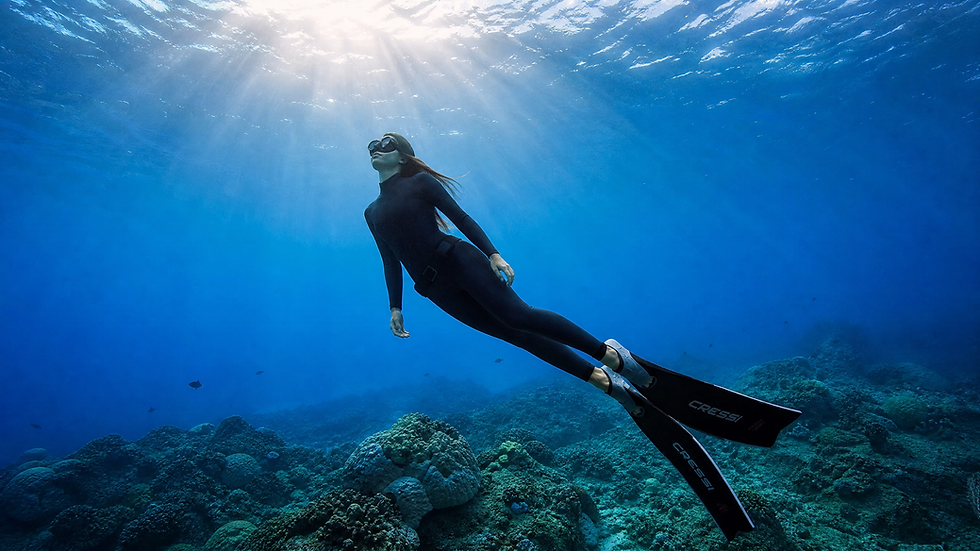
The dive itself should feel like letting go. Sink into the water, equalize early and often, and let your body do what it's naturally inclined to do once you get past the first five metres: get heavier, quieter, and more negatively buoyant.
Advanced freedivers call this the "free fall" zone — the depth (usually 10 to 15 metres depending on your body composition) where you stop actively kicking and simply glide down, pulled by gravity and the weight of water above you.
This is one of the most extraordinary feelings in any water sport. And it starts with that final breath.
CO2 Tolerance Training: Building the Calm That Makes You a Better Freediver
Here is an uncomfortable truth about freediving that nobody advertises: the discomfort you feel during a dive is mostly mental before it's physical. The diaphragm contractions that hit at the end of a breath-hold — those involuntary jolts that your body uses to say "breathe now" — can be felt while you still have plenty of oxygen.
Learning to stay calm through them is literally a trainable skill, and this is what CO2 tolerance training is all about.
CO2 tolerance tables are structured breath-hold exercises (done safely, ideally with a trained buddy, never alone) that gradually expose you to elevated CO2 levels in a controlled way. A classic CO2 table involves performing a series of breath-holds of a fixed duration with decreasing rest periods between them — which causes CO2 to accumulate slightly before each hold.
Over time, your body and mind adapt. You stop reading those early CO2 signals as emergencies. You learn to stay soft and still at depth, conserving oxygen, watching reef fish drift past your mask with the kind of calm that looks effortless from the outside but takes real practice to develop.
Recovery Breathing: What You Do After a Freedive Matters as Much as What You Do Before
Most new freedivers give zero thought to what happens when they surface. They come up, rip off the snorkel or mask, take a few ragged gasps, and immediately go again. This is a mistake — and a potentially dangerous one.
Recovery breathing is the structured sequence of breaths you take after surfacing to properly restore your oxygen levels and clear CO2 before your next dive. It typically involves three to five deep, deliberate breaths: exhale fully, then inhale slowly and completely, repeating until you feel genuinely ready — not just impatient.
A good rule of thumb: rest on the surface for at least twice as long as your dive duration before your next breath-hold. So if you dove for 45 seconds, take 90 seconds on the surface.
Rushers who ignore this rule hit a fatigue wall fast — and in a competitive pool session or guided ocean dive, that wall can arrive at the worst possible moment. Breathe through your snorkel, float on your back if you can, and let the ocean do the work of holding you up for a minute. Your next dive will be better for it.
Dress Like You're Going to Be in the Ocean All Day (Because You Are)
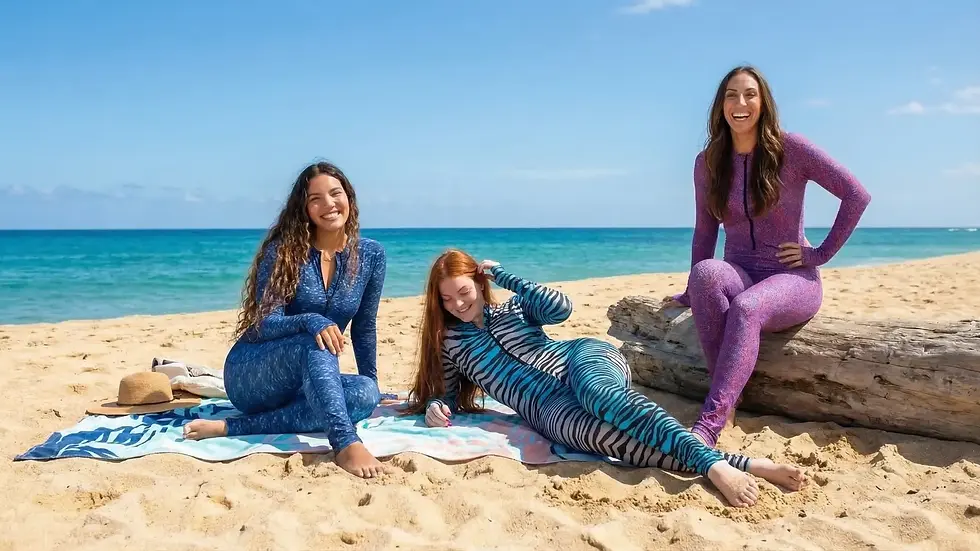
One thing that doesn't get nearly enough attention in freediving conversations: the hours you spend at the surface between dives. If you're training or on a freediving trip, that's a significant amount of time in direct sun — floating on your back, sitting on a platform, surface resting with your face to the sky. That sun exposure adds up fast, and it's one of the most consistently underestimated hazards of a day of freediving.
Plunge Waterwear's UPF 50+ Dive Suits were built for exactly this. They're lightweight and four-way stretch so they don't fight your body on the way down — freedom of movement matters enormously in freediving, where every ounce of physical tension translates to oxygen consumed.
They also block 98% of UV radiation, meaning that every surface interval, every breathe-up, every lazy float between dives is time your skin is protected rather than accumulating damage. For warm-water ocean training, a good UPF dive suit is the piece of gear that quietly does the most work — not the loudest, most technical item in your kit, but one you'll absolutely notice the absence of.
What the Fish?!
Meet the Leafy Sea Dragon: The Ocean's Greatest Disappearing Act

If you have ever snorkeled or dived off the coast of southern Australia and not seen a leafy sea dragon, there's a reasonable chance you were looking right at one. Phycodurus eques is arguably the most spectacular example of camouflage in the vertebrate world — a fish so thoroughly disguised as drifting kelp that it doesn't just blend in, it essentially ceases to exist as a fish.
Every part of its body is adorned with elaborate, leaf-like appendages that wave in the current exactly as seaweed does. Its propulsion — two tiny, almost transparent fins that beat up to 70 times per second — is invisible to the naked eye, so when a leafy sea dragon moves, it appears to simply drift, carried by the water with no will of its own.
Like its seahorse relatives, it's the male who carries the eggs — up to 250 of them, attached to a brood patch under his tail. Found exclusively in the cold, kelp-rich waters of southern and western Australia (they're the marine emblem of South Australia, which tells you how seriously Australians feel about them), leafy sea dragons feed entirely on mysid shrimp, which they vacuum up through their long tube-shaped snout.
They have no stomach, which means they have to eat almost constantly. For a creature that barely moves, it's a surprisingly demanding existence. Spot one on your next southern Australia dive, and you'll understand exactly why seasoned divers still talk about it years later.
The Breath That Changes Everything
Here's the beautiful thing about freediving breathing techniques: they don't just make you a better freediver. They change how you move through the world above the surface, too. Breath awareness — genuinely paying attention to how you inhale, how you exhale, where you hold tension and where you release it — is a skill that transfers.
Many freedivers find that their relationship with stress, sleep, and anxiety shifts after spending serious time learning to work with their breath rather than against it.
But the ocean is still where it all comes together. There's nothing quite like the moment when your breathe-up is complete, your final breath is in, and the surface tension of the water gives way above you. You're in.
The blue is all around you. And for a few moments, the whole world is just you, the pressure, and the sound of your own heart slowing down. That's freediving. That's what the breath can give you. And it starts with learning how to use it.
Until next time — Stay Salty!


Comments