
Ocean Depth Zones Explained: What Lives in the Dark Below Your Fins
- Plunge Waterwear
- Apr 22
- 7 min read

Every time you slip beneath the surface, you enter a world governed by layers — distinct ocean depth zones that stack from the sun-drenched shallows all the way down to crushing, lightless trenches that human eyes have barely ever seen. Most divers spend their entire careers in the top sliver of water, the lit and familiar zone above 200 meters. But understanding what lies below — and what extraordinary life has evolved to thrive there — changes the way you see the entire ocean. It makes every breath-hold and every descent feel like you're standing at the edge of something much, much bigger than yourself.
The Ocean Depth Zones: A World Built in Layers
Scientists divide the ocean into five major depth zones, each one defined by the amount of light that reaches it, the temperature, the pressure, and the life forms that can survive there. Think of it less like a gradient and more like a series of alien planets stacked beneath your boat. The further down you go, the stranger — and more spectacular — things get. Here is what the ocean looks like, layer by layer.

Zone 1: The Sunlight Zone (Epipelagic) — 0 to 200 Meters
This is your zone. If you have ever freedived, scuba dived, or snorkeled, you have spent your entire underwater life here. The sunlight zone extends from the surface down to about 200 meters — the depth to which enough light penetrates to support photosynthesis. It is the most biologically productive part of the ocean, home to the vast majority of marine life we know and love: coral reefs, sea turtles, reef fish of every color, dolphins, sharks, and the plankton that forms the base of nearly every marine food chain. The water is warm (in tropical waters, typically 20 to 30°C near the surface), clear enough to see your dive buddy, and full of life at every turn. It is also where most of us spend 100% of our time — which means the other 95% of the ocean's volume remains, for most people, completely unknown.
Zone 2: The Twilight Zone (Mesopelagic) — 200 to 1,000 Meters
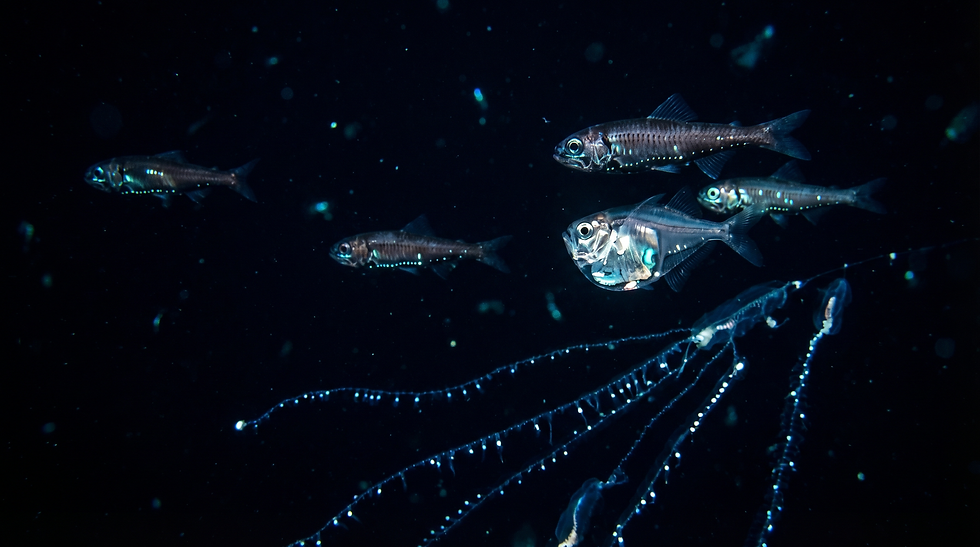
This is where the ocean starts to feel genuinely alien. Below 200 meters, sunlight fades to a dim, blue-green twilight — enough to see shapes, but not enough to power photosynthesis. The pressure is building (at 200 meters, you feel roughly 21 atmospheres of pressure), the temperature drops sharply, and the creatures here have evolved some of the most extraordinary adaptations on the planet. Many mesopelagic animals are bioluminescent — they produce their own light to communicate, lure prey, or camouflage themselves from predators looking up from below. The lanternfish, the hatchetfish, and the siphonophores live here. So do the bristlemouth fish, which are thought to be one of the most numerous vertebrates on Earth — and most people have never heard of them. The twilight zone is also home to one of the ocean's most spectacular daily events: the deep scattering layer, in which billions of organisms migrate upward toward the surface every night to feed, and descend again at dawn to escape the light.
Zone 3: The Midnight Zone (Bathypelagic) — 1,000 to 4,000 Meters
No sunlight. Ever. The midnight zone is a world of total, permanent darkness, and the pressure here — between 100 and 400 atmospheres — is enough to crush most submarines. The temperature hovers just above freezing, and yet life persists. The creatures here are some of the most dramatic on Earth: the anglerfish with its bioluminescent lure dangling above a mouth full of needle-like teeth; the giant squid, which can reach lengths of up to 13 meters; the viperfish with its transparent body and fang-like teeth that point backward so that prey cannot escape once caught. Most of what we know about this zone has been gathered by deep-sea remotely operated vehicles (ROVs), and new species are still being discovered with almost every expedition. Scientists estimate we have explored less than 20% of the deep ocean — which means the midnight zone remains one of the most unexplored environments on our entire planet.
Zones 4 and 5: The Abyss and the Hadal Zone — Where Life Shouldn't Exist
The abyssal zone (4,000 to 6,000 meters) covers more than half of the entire ocean floor. It is flat, featureless, and near-freezing — and yet it teems with life in ways scientists are still piecing together. Sea cucumbers carpet the abyssal plain, filtering organic material that drifts down from the zones above. Brittle stars, sea spiders, and deep-sea snailfish make their living here. Then there is the hadal zone — the ocean trenches that plunge to 11,000 meters or more. The Mariana Trench in the Pacific Ocean is the deepest point on Earth at approximately 10,935 meters. In 2019, explorer Victor Vescovo descended to this depth in a submersible and found, among other things, a plastic bag. Even the most remote ocean depth zones are not safe from human impact. Despite the pressure (more than 1,000 atmospheres at full hadal depth), life is there. The amphipod crustaceans that swarm in hadal trenches are some of the most pressure-adapted organisms ever discovered, and researchers continue to find new species in the deepest dives.
Why Understanding Ocean Depth Zones Makes You a Better Diver
You might be wondering: I only dive in the sunlight zone, so why does any of this matter to me? The answer is context. When you understand the full vertical scale of the ocean — when you know that the 30-meter reef wall you are freediving is barely the opening paragraph of a story that stretches 11 kilometers deeper — it fundamentally reshapes your relationship with the water.
It also makes you a better advocate for ocean conservation. The deep ocean is the planet's largest carbon sink — absorbing enormous quantities of CO2 from the atmosphere. It regulates global climate patterns. The species living in those deepest zones are connected, via food webs and nutrient cycles, to everything in the shallows. The reef fish you photograph on your GoPro depend, in indirect ways, on processes happening in the midnight zone, 3,000 meters below your fins. The ocean is one system, not five separate ones — and the zones are just the labels we put on it to make sense of the scale.
The Thermocline: Where the Ocean Depth Zones Meet Your Body
One thing every diver who pushes past shallow recreational depths will encounter is the thermocline — the abrupt boundary where warm surface water meets significantly colder deep water. In many tropical dive sites, you will hit this layer between 15 and 30 meters: a sudden, almost visible shimmering in the water, like looking through imperfect glass, accompanied by a dramatic drop in temperature. The thermocline marks the transition between the upper and lower parts of the sunlight zone, and in some locations hints at the deeper world waiting below. Freedivers heading past 30 meters will feel it acutely. For scuba divers, it is often when visibility changes and the water takes on a darker, more serious character. For snorkelers drifting over deep water, the thermocline is that faint, slightly vertiginous sensation of looking down into blue that goes on forever — and knowing, now, exactly what is down there.
Gear Up for Your Zone — and Protect Yourself While You're There

Whether you're freediving a 40-meter wall, snorkeling over a shallow reef, or floating on the surface above open water that drops to 4,000 meters of midnight zone beneath you, you're still spending a significant amount of time exposed to sun. And that's the piece most divers underestimate — not the diving itself, but everything around it: the surface intervals, the boat rides, the hours spent gearing up on deck under a tropical sky.
Plunge Waterwear's UPF 50+ Dive Suits are designed for exactly this kind of lifestyle. Lightweight, flexible, and rated to block 98% of UV radiation, they keep you protected from the moment you step onto a boat to the moment you towel off after your last dive. They don't restrict your movement in the water — so whether you're chasing depth or just drifting over the shallows, you can focus entirely on the ocean, not on reapplying sunscreen every 90 minutes. Think of it as the right gear for the zone you actually live in: the sunlight zone, where the light hits hard and the water is stunning.
What the Fish?!

Meet the Bobtail Squid — The Ocean's Tiniest Nightlight
It is smaller than your thumb. It lives in shallow, sandy coastal waters. It glows in the dark — but not from within itself. The bobtail squid (order Sepiolida) has solved one of the ocean's classic survival problems — how to avoid casting a shadow that predators below can spot — by outsourcing the solution entirely. It carries a colony of bioluminescent bacteria (Aliivibrio fischeri) in a specialized light organ on its underside, and it calibrates the bacteria's glow to exactly match the faint downwelling light from above. From below, the squid is essentially invisible. It is one of the most elegant examples of symbiosis in the animal kingdom: the squid gives the bacteria a home and a nutrient supply; the bacteria give the squid its cloak of invisibility. Scientists have spent decades studying this relationship, and it has become one of the most important models for understanding how beneficial bacteria work — including the bacteria that live inside our own bodies. Found in tropical and subtropical coastal waters across the Indo-Pacific, the bobtail squid is also, for the record, absolutely adorable. Google it. We'll wait.
The Ocean Is Deeper Than You Think. And That's the Best Part.
Here is the thing about understanding the ocean depth zones: it makes the sunlight zone — your zone, our zone — feel even more precious. You're floating at the absolute top of a system that extends for nearly 11 kilometers beneath you. The reef fish darting around your fins are neighbors to animals that have never seen sunlight, never felt warmth, never experienced anything but cold and dark and pressure. And yet they share the same water. The same planet. The same fate if we don't protect it.
Dive deep in your knowledge, even when you're diving shallow. The ocean rewards the curious.
Stay Salty!
~ The Plunge Waterwear Team


Comments