
How to Protect Yourself from Jellyfish Stings While Diving & Snorkeling — And Why Full Coverage Matters

Why Jellyfish Sting Protection Deserves a Spot in Every Diver's Toolkit
You've done the research. You've picked your destination, booked the dive, packed your fins. And then someone mentions jellyfish. Not in a scary way — just casually. "Oh yeah, it's jellyfish season there right now." And suddenly the thing you were so excited about has a small asterisk next to it.
Here's the truth: jellyfish are a completely manageable part of diving and snorkeling — and with the right jellyfish sting protection in place, they don't need to slow you down at all. But the advice most people get is vague at best. Wear a wetsuit. Apply vinegar. Don't panic. Not exactly a strategy.
This post gives you the full picture: why stings happen, what actually protects you (spoiler: the answer is simpler and more satisfying than you think), and how to put together a protection system that works every time you enter the water — whether you're snorkeling a tropical bay or diving a deep wall covered in hydroids.
Why Jellyfish Stings Happen (And Why Some People React More Than Others)
Jellyfish don't sting you because they're aggressive. They sting because you've made contact with their tentacles — which are armed with microscopic, coiled structures called nematocysts that fire on contact with skin and inject venom. They don't care if you're a threat or a tourist. Any pressure or chemical trigger sets them off.
The severity of a sting varies enormously. Species, the part of the body contacted, the individual's sensitivity, and how much tentacle actually makes contact all play a role. A brief brush with a moon jellyfish in the Mediterranean might leave you with nothing more than mild irritation. Full contact with a box jellyfish or a Portuguese man o' war is a medical emergency.
Which Jellyfish Are Most Likely to Sting Divers and Snorkelers?

Most encounters are with species in the mild-to-moderate category — moon jellyfish, lion's mane jellyfish, sea nettles, and various hydroids and fire coral. These are widely distributed across popular dive and snorkel destinations and are the most common source of the "I got stung" stories you hear at the dive deck.
The genuinely dangerous species — box jellyfish (Chironex fleckeri and its relatives) and the Irukandji jellyfish — are concentrated in specific regions, primarily northern Australian waters and parts of Southeast Asia. If you're diving in those areas, local knowledge is essential. Check with your dive operator about seasonal presence and recommended precautions before you enter the water.
What Actually Protects You: Full Coverage Beats Everything Else

Here's where the conversation about jellyfish sting protection usually goes wrong: people focus on topical solutions — stinger suits with mesh panels, sprays, creams — when the most effective protection is the most obvious one. Physical barrier coverage.
A jellyfish can only sting skin it can reach. That's it. That's the whole logic.
This is why surfers in stinger-prone areas wear full wetsuits. It's why serious divers in northern Queensland don tropical stinger suits in the summer months. And it's why the single most effective upgrade you can make to your jellyfish protection setup is moving from minimal coverage to full-body coverage.
Jellyfish Sting Protection and Why the Fabric Choice Matters
Not all full-coverage suits are created equal when it comes to jellyfish sting protection. There are two key factors: how much skin the suit covers, and how the fabric interacts with nematocysts.
Nematocysts fire in response to a combination of physical pressure and chemical contact with skin. Synthetic fabrics — particularly tightly woven nylon and spandex blends — create a layer that is both physically smooth and chemically inert, giving nematocysts less to react to compared to bare skin. Polyester blends can work, but nylon-spandex construction tends to have a finer weave and a more consistent barrier.
Coverage matters just as much as fabric. A rashguard covers your torso but leaves your legs exposed. Separates (top and bottom) leave a gap at the waist. A one-piece or full-length dive skin eliminates those gaps — which is where tentacles reliably find you.
How Plunge Waterwear Dive Suits Solve the Problem
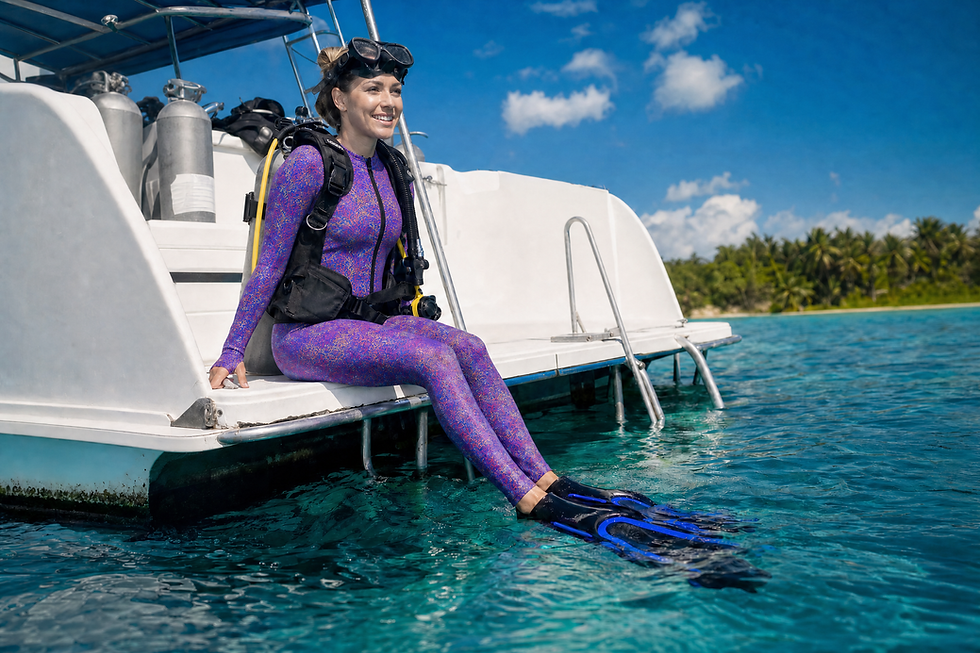
Our UPF 50+ Dive Suits were designed for people who spend serious, extended time in and around the ocean. That means they needed to solve multiple problems at once — and jellyfish sting protection is one of the most practical ones they address.
Here's what makes the difference:

Seamless full-body coverage — no gap at the waist, no exposed strip of lower back, no unguarded zone between your gloves and your suit cuff. The suit covers what it covers completely.
Four-way stretch construction — because a suit that fights your body is a suit you won't wear. Our dive suits move with you: on a descent, through a duck dive, mid-kick. There's no resistance, no bunching, no pulling at the shoulders. You don't feel like you're wearing protection. You just feel covered.
Nylon-spandex fabric — smooth, fine-weave, and body-close enough to function as a genuine physical barrier. This is not a baggy rashguard that flaps against your skin. It lies flat and moves with you, keeping the barrier consistent.

UPF 50+ — because jellyfish aren't the only hazard in the water. While your dive suit is doing the work of blocking tentacle contact, it's simultaneously blocking 98% of UV radiation. The surface intervals, the boat rides, the long morning snorkel in perfect flat water — all of it covered, without a single application of sunscreen.
You're not buying a specialist piece of jellyfish-specific gear. You're buying a suit that handles sun protection, jellyfish protection, fire coral protection, and skin-on-reef protection all at once. It's the single most useful piece of fabric you can put on before entering the ocean.
Other Layers of Protection Worth Adding

A dive suit covers the most ground, but a complete jellyfish sting protection approach uses a few additional layers.
Timing and local awareness is your first line of defense. In many destinations, jellyfish have seasonal peaks — often tied to water temperature, currents, and wind direction. Talk to local dive operators, check current conditions, and if the answer is "yes, there are a lot of them right now," plan your dive entry and exit accordingly. Night snorkeling, when many jellyfish migrate upward to surface waters, carries elevated contact risk in stinger-prone areas.
Headbands and ear/neck protection matter more than most people realize. The face and neck are some of the most sensitive areas for sting reactions — and they're often left completely exposed. Plunge Waterwear's headbands protect your hairline and ears, which are common contact zones when swimming through jellyfish-rich water, and they pair naturally with the full suit to close off another gap.
Reef awareness applies even to jellyfish. Many of the most painful stings in tropical water don't come from free-floating jellyfish at all — they come from hydroids, fire coral, and other cnidarians attached to the reef. These are easy to brush against accidentally while hovering, reaching for a camera, or navigating a narrow swim-through. Staying aware of your body position underwater — especially your trailing legs and arms — reduces contact with all of them.
Post-sting protocol is worth knowing before you need it. If a sting does occur: rinse with sea water (not fresh water, which can trigger unfired nematocysts). Remove visible tentacle material without rubbing — use a card or gloved hand. Vinegar is recommended for some species (notably box jellyfish); heat application works well for others. When in doubt, seek local medical advice. An antihistamine can help manage the reaction.
What the Fish?!
Meet the Mauve Stinger: The Jellyfish That Glows, Stings, and Travels in Millions

Pelagia noctiluca sounds like a spell from a fantasy novel, and honestly, it kind of is. The mauve stinger is one of the most widely distributed jellyfish in the world — found throughout the Mediterranean, the Atlantic, the Pacific, and the Indian Ocean — and it has a trick up its translucent sleeve that most people don't know about: it's bioluminescent.
Touch one in the dark, and it lights up. Disturb a night-time bloom of mauve stingers from the side of a boat, and the water pulses with blue-green light like something dreamed up by a visual effects studio. Every tentacle, every bell contraction — lit from within. It's one of the most beautiful things the ocean does, and it happens to be attached to one of the most reliably stinging jellyfish on the planet.
The mauve stinger is responsible for a huge proportion of sting reports from Mediterranean beaches and open-water swimmers in Atlantic coastal areas. Unlike larger jellyfish that you can see coming, P. noctiluca tends to travel in dense blooms — millions of individuals, sometimes covering square kilometres of surface water. Swim into the edge of one at dusk and you'll know about it immediately.
It has both tentacles and oral arms covered in stinging cells, and its sting causes a burning, itching, sometimes raised welt that can last for hours. Rarely dangerous, but reliably unpleasant — and its small size (bell diameter of 3–12 cm) means you often don't see it until you're already in it.
The name noctiluca means "night light" in Latin. For something so persistently annoying, it earned a genuinely beautiful name.
The Simplest Jellyfish Strategy: Cover Up and Get In the Water
Jellyfish sting protection doesn't need to be complicated. It doesn't need a cupboard full of specialist sprays or a pre-dive ritual that takes longer than your breathe-up.
Cover your skin. Know your destination. Understand the conditions. And get in the water — because the ocean, jellyfish and all, is still the most extraordinary place on Earth.
The divers who stay home during jellyfish season are missing some of the best diving of the year. In many locations, high jellyfish presence coincides with exceptional visibility, calm water, and peak marine life activity. Don't let the stingers win.
Put on your suit. Dive in. Stay curious.
Until next time — Stay Salty!
~ The Plunge Waterwear Team


Comments