
The Best Freediving Destinations in the World (And What to Know Before You Descend)
There's a moment every freediver knows. You've equalized, your arms are swept back, and the surface — with all its noise and movement — has gone silent above you. There's nothing between you and the blue. No bubbles. No engine hum. Just water, pressure, and whatever is waiting below. Finding the right freediving destination is about finding the place that makes that moment feel like magic.
And the good news? The world is full of them.
Whether you're chasing crystal-clear visibility to sharpen your technique, hunting for dramatic underwater topography to explore, or simply looking for a warm, calm stretch of sea where you can drift over coral and forget what time it is — there is a freediving destination that was made for you. This guide covers the best of them: what makes each one special, the best time to go, and what to prepare for before you descend.
Why the Right Freediving Destination Changes Everything
Freediving is uniquely sensitive to environment in a way that scuba diving isn't. When you're dependent on a single breath, conditions matter enormously. Visibility affects how far you can see and how relaxed you feel. Thermoclines affect your breath-hold and your body's response to depth. Current affects your energy expenditure. Surface conditions affect your recovery.
A great freediving destination isn't just beautiful — it's supportive. It gives you warm, calm water to relax in. It gives you visibility that rewards the descent. It gives you something worth seeing when you get there.
What Makes a Freediving Location Ideal
The short answer: visibility, depth access, warmth, and marine life. The longer answer involves finding somewhere with gentle surface conditions so your recovery floats are restful, a freediving community or operator on the ground so you're never diving alone, and ideally, a thermocline deep enough that you're not working against cold water in your first ten metres. The places below tick most or all of those boxes.
The World's Top Freediving Destinations
Dahab, Egypt — The Freediving Capital of the World
If you ask any serious freediver where they've spent the most time training, there's a good chance the answer is Dahab. This small Sinai town on the Red Sea has become the undisputed global hub for competitive and recreational freediving, and for very good reason.

The Blue Hole — a submarine sinkhole with a vertical wall dropping to over 100 metres — provides accessible depth in a compact, manageable space. You can train your equalisation, work on your technique, and socialise with world-record holders, all from the same stretch of shore. Water temperatures hover between 22°C and 27°C through most of the year. Visibility regularly exceeds 30 metres.
Beyond the Blue Hole, Dahab offers the Canyon, the Eel Garden, and a dozen other sites that reward exploration. There's a strong freediving school community here, and if you're looking to get certified or move up through the AIDA or Molchanovs levels, Dahab is one of the best places on the planet to do it.
Best time to visit: March to May, September to November for optimal conditions and cooler surface temps.
The Tubbataha Reef, Philippines — Remote, Wild, and Worth Every Effort

The Philippines as a whole deserves a place on every freediver's bucket list — clear, warm water, extraordinary biodiversity, and a freediving culture that runs deep in local communities, particularly in places like Oslob and Moalboal on Cebu. But for sheer underwater spectacle, it's hard to beat Tubbataha Reef in the Sulu Sea.
Tubbataha is a UNESCO World Heritage Site and one of the most biodiverse marine areas in Southeast Asia. Pelagic species — sharks, manta rays, whale sharks, and schools of jack that blot out the light — share the water with healthy coral walls dropping into the abyss. The water is almost impossibly clear.
Access requires a live-aboard — the reef sits far offshore — which makes it a committed destination. But for a freediver who wants to feel genuinely small in a big, healthy, thriving ocean, Tubbataha delivers something few places on earth can match.
Best time to visit: March to June (access is strictly seasonal and weather-dependent).
Tenerife, Canary Islands — Europe's Best-Kept Freediving Secret
For European freedivers, Tenerife is the answer to the question: "Where can I train year-round without flying to the Red Sea?" The Canary Islands sit just off the Moroccan coast, which means they stay warm when the rest of Europe freezes — water temperatures rarely drop below 18°C even in winter, and climb to 23°C in summer.
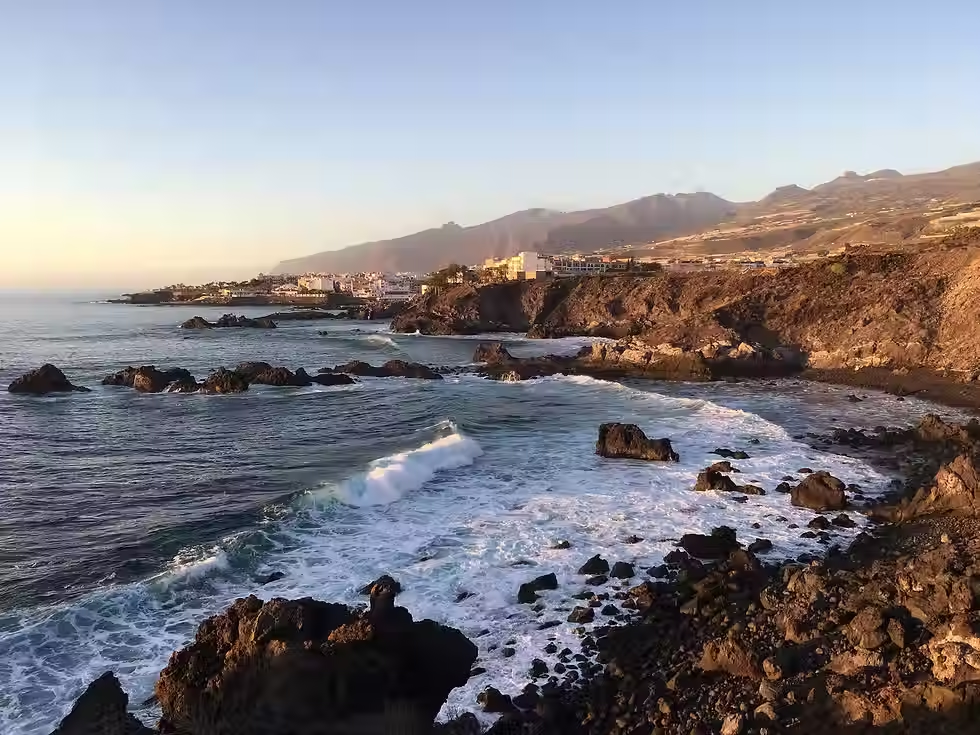
What makes Tenerife special for freedivers is the underwater topography. Volcanic rock formations create dramatic walls, caves, and vertical faces that reward exploration on a single breath. The Atlantic brings good visibility and a healthy pelagic scene, with angel sharks, rays, and barracuda common in the shallower reefs.
Tenerife also has a growing freediving community, with multiple operators offering courses, guided dives, and buoy rentals. It's accessible, affordable, and chronically underrated.
Best time to visit: Year-round. Winter avoids the summer tourist peak while still offering great conditions.
The Maldives — Drift Diving, Mantas, and Absolute Clarity
The Maldives is not the most intense freediving destination on this list, but it might be the most beautiful. Warm, gin-clear water. Coral atolls you can snorkel across in minutes. Resident manta ray populations at cleaning stations you can hover above on a single breath and watch for as long as your lungs allow.

The Maldives is ideal for freedivers who want to combine training with marine life encounters that are genuinely awe-inspiring. Channels between atolls create drift conditions that reward experienced divers, but the lagoons and reef edges are accessible and gentle enough for those building their confidence.
A freediving destination this gorgeous also comes with one practical consideration: the tropical sun is relentless. You're spending hours at the surface between dives, floating face-down in direct sunlight with your back exposed. UPF 50+ protection isn't a luxury here — it's a necessity.
Best time to visit: December to April for calm seas and optimal visibility.
Kona, Hawaii — Big Animals and Big Depth

Hawaii doesn't always make the shortlist for freediving destinations, but Kona on the Big Island earns its place convincingly. The water clarity on the leeward coast is spectacular — regularly 30+ metres of visibility. The marine life is extraordinary: spinner dolphins, manta rays, Hawaiian green sea turtles, and occasional humpback whales in winter.
Kona is also home to one of the most famous night dives in the world, where manta rays aggregate in their dozens to feed on plankton attracted by lights.
Witnessing that on a breath-hold, hovering silently as mantas loop beneath and above you, is the kind of experience that makes you forget you were ever afraid of the dark.
For competitive freedivers, the deep, open-water access off Kona is excellent for depth training in a blue-water environment.
Best time to visit: June to October for flat, calm conditions. Humpbacks present December to April.
Protecting Your Skin at Every Freediving Destination
Here's the thing every experienced freediver eventually learns: the ocean doesn't care about your sunscreen. Not because sunscreen is useless — it's not — but because no cream survives hours of salt water immersion, surface time, and repeated dunking. By your third dive of the morning, your shoulders are unprotected.
This is where a UPF 50+ Dive Suit changes the equation entirely. At every freediving destination on this list, you're spending extended time in the water — surface intervals, warmup dives, long floats between sets. Every minute your back is above the waterline in tropical sun, UV radiation is doing its work.
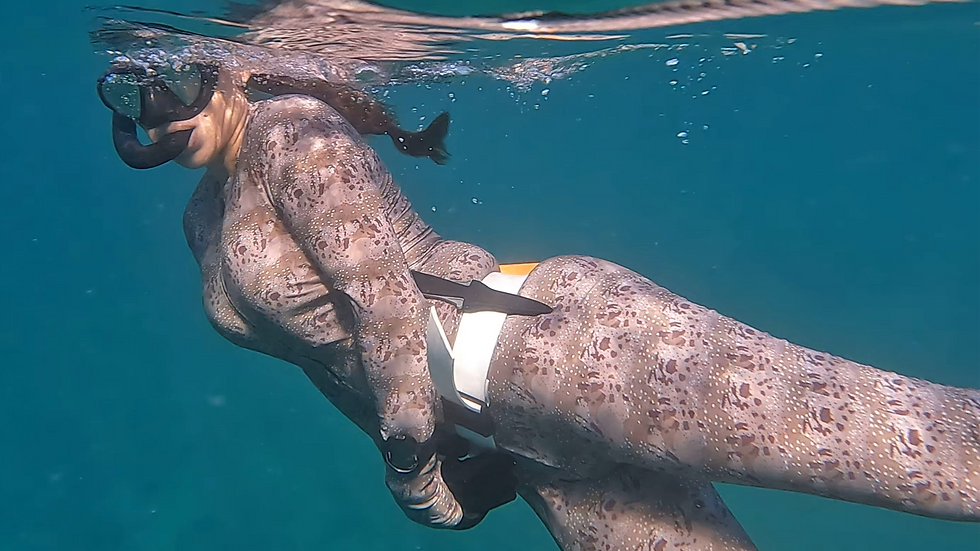
Plunge Waterwear's UPF 50+ Dive Suits are built exactly for this kind of water time. The four-way stretch construction moves with every kick and arm pull — no bunching, no restriction, no suit that fights you on the descent. The smooth, close-knit nylon-spandex fabric provides genuine UPF 50+ protection without the bulk of a wetsuit, meaning you stay comfortable in warm-water destinations and protected during the surface time when the sun is most relentless.
They're also light enough to pack without drama — important when your luggage is already carrying fins, masks, and a weight belt.
What the Fish?!
Meet the Tasselled Wobbegong: The Reef's Most Committed Couch Potato
If you've ever spent time diving the reefs of Australia, Papua New Guinea, or Indonesia and wondered whether that patch of rubble-covered rock just blinked at you — it probably did.
The tasselled wobbegong (Eucrossorhinus dasypogon) is a carpet shark so committed to doing absolutely nothing that the ocean has essentially built a disguise around it.

It grows to around 1.8 metres long and spends most of its life lying completely flat on the seafloor, covered in a fringe of skin flaps and lobes around its head that break up its outline so perfectly it's nearly impossible to spot unless you know what you're looking for. Algae and sponges sometimes grow on its skin.
Fish swim over it. Divers swim over it. Nobody notices.
And then, when something edible gets close enough, the wobbegong strikes with a speed that genuinely does not look possible for something that appeared to be asleep. It can swallow prey almost its own size.
Here's the kicker: it's been documented luring fish toward it by slowly waving its tail, which apparently resembles a small fish swimming along the bottom. It doesn't just wait. It fishes.
Spotted on a reef? Give it serious space — and maybe double-check the rock you're about to put your hand on.
Choose Your Depth
Every freediving destination on this list offers something slightly different — some are about epic marine life, some are about dramatic topography, some are about community and training. What they share is the quality that matters most: they reward the descent.
Do your research, pick a destination that fits your level and your goals, and show up prepared — with your certification current, a buddy in the water, and protection from the elements sorted before you get in. The ocean will take care of the rest.
Go slow. Breathe deep. Stay salty.
Until next time — Stay Salty! ~ The Plunge Waterwear Team


Comments