
Coral Reef Restoration: How Divers Are Helping Bring Reefs Back to Life
- Plunge Waterwear
- Apr 1
- 5 min read

You drop down to fifteen metres, neutralize your buoyancy, and hover above a section of reef that looks like a graveyard. Pale white skeletons where staghorn and brain coral used to be. Ghost-pale rubble where fish were darting between branches just a decade ago. It stops you cold — even mid-dive. This is what coral bleaching looks like up close, and once you’ve seen it, you can’t unsee it.
But here’s the thing — and this is why coral reef restoration has become one of the most exciting fields in ocean science right now — it doesn’t have to stay that way. Reefs are resilient, given half a chance. And divers, more than anyone else on the planet, are in a unique position to help give them exactly that.
Why the Reefs Need Us: The Scale of Coral Reef Restoration

Let’s be honest about the numbers, because they matter. According to scientists at the Global Coral Reef Monitoring Network, the world has lost roughly 50% of its coral reefs since the 1950s. The Great Barrier Reef has experienced four mass bleaching events since 2016 alone. The Caribbean has lost more than 80% of its coral cover over the last four decades. These aren’t distant statistics — they describe places where divers, snorkelers, and ocean lovers have dived, and found them quieter and emptier each time they returned.
The primary drivers are well-documented: rising sea temperatures caused by climate change trigger bleaching events, where coral expels the algae living in its tissue and turns white. Pollution, agricultural runoff, coastal development, overfishing, and physical damage from anchors and careless fin-kicks compound the stress. The reef doesn’t have a single enemy — it has many. Which means that recovery requires action on multiple fronts simultaneously.
How Coral Reef Restoration Actually Works

The most exciting technique in reef science right now is coral gardening — where small fragments of healthy coral are grown in underwater nurseries and then transplanted onto degraded reef sections. Think of it as farming coral from the sea floor up. Organisations like the Coral Restoration Foundation in Florida have grown and transplanted hundreds of thousands of coral fragments onto degraded reef sections in the Florida Keys. The best programs use heat-tolerant coral genotypes — strains that have already survived bleaching events — giving transplanted colonies the best possible fighting chance as temperatures continue to rise.
Coral Reef Restoration Programs Around the World
Beyond Florida, coral reef restoration is global. The Coral Triangle — spanning Indonesia, the Philippines, Papua New Guinea, Malaysia, Solomon Islands, and Timor-Leste — has become a focus of large-scale work by the Nature Conservancy and the Mars Coral Reef Restoration Program. In Australia, the Great Barrier Reef Foundation is funding coral spawning research and assisted evolution. Across the Maldives, Fiji, and the Red Sea, dive operators and marine biologists are working side by side on restoration that their entire livelihoods depend on. This is a worldwide movement, and it’s picking up speed.
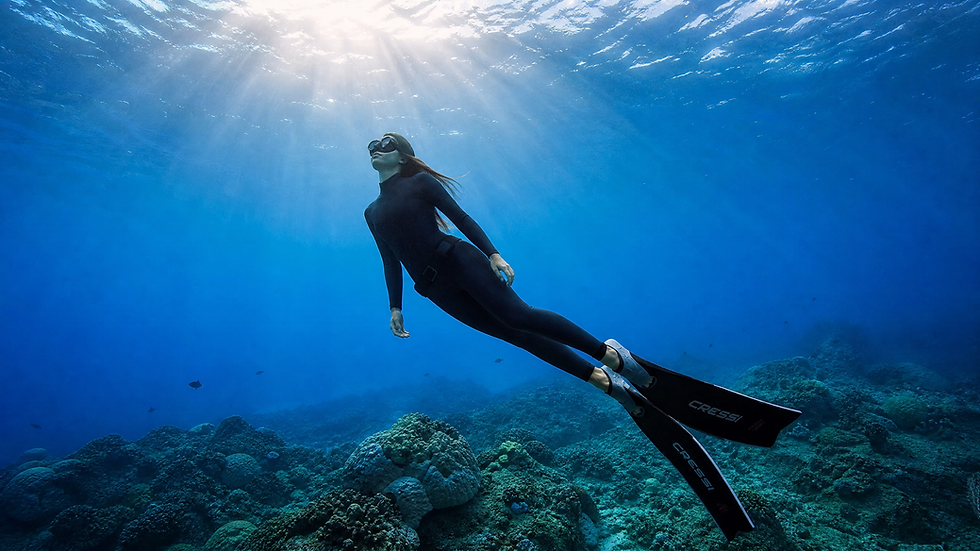
You don’t have to be enrolled in a formal restoration program to make a difference. Honestly, the most powerful things most divers can do are the basics — done consistently, by a lot of people. Perfect your buoyancy so you never touch the reef (this one is non-negotiable — a single careless fin-kick can destroy ten years of coral growth). Anchor responsibly and choose operators who use mooring buoys rather than dropping iron onto living reef. Report bleaching events or crown-of-thorns starfish outbreaks to your dive centre or directly to the Reef Health Incident Response Tool. Choose reef-safe, mineral-based sunscreen and minimise the amount you need by wearing a full-coverage UPF suit in the water.
That last point is something we care about deeply at Plunge Waterwear. Every time a diver or snorkeler enters the water in a UPF 50+ full-coverage dive suit instead of lathering up with chemical sunscreen, they’re reducing the amount of oxybenzone and octinoxate going into the water. These chemicals — found in most conventional sunscreens — have been shown to cause coral bleaching, disrupt coral reproduction, and contribute to coral DNA damage even at very low concentrations. Hawaii, Palau, Bonaire, and other reef-forward destinations have already banned them for exactly this reason.
Our UPF 50+ Dive Suits give you full-body coverage from the moment you step on the boat — protecting your skin from UV, physical abrasions from coral, jellyfish grazes, and the long cumulative exposure that comes from spending real time in the water. They’re lightweight enough for freediving and warm-water snorkeling, quick-drying for boat days, and designed with four-way stretch that doesn’t restrict your movement or your ability to hover neutrally above a reef you’re trying to protect. Less sunscreen in the water, more protection for you. It’s a win for your skin and a win for the ecosystem — and that matters to us.

What the Fish?!
Meet the Mantis Shrimp: The Most Terrifyingly Cool Thing on the Reef

The mantis shrimp (order Stomatopoda) is not a shrimp. It is not a mantis. It is, however, one of the most astonishing animals on earth, and it lives right there in the reef crevices you’re hovering above on every tropical dive — and you probably walk right past it.
The peacock mantis shrimp (Odontodactylus scyllarus) is arguably the most colourful animal in the ocean — its armoured body blazes with electric orange, red, green, and blue, looking less like a crustacean and more like a jewel that has developed opinions. But its colour is not even its most impressive feature. Its striking appendages — called dactyl clubs — can accelerate faster than a bullet from a gun, delivering a blow with the same force as a .22 calibre bullet and generating cavitation bubbles that produce a second shockwave even after the initial impact. It can punch through aquarium glass. It has been known to punch through the fingers of marine biologists who got too curious. Its eyes contain 16 types of colour receptors (humans have three), meaning it sees wavelengths of light we don’t even have names for. It’s essentially a tiny, gorgeous wrecking ball that sees colours you’ve never dreamed of. The reef is full of surprises, and this one might be the biggest.
The Reef Is Fighting Back — and So Are We

There’s a version of the story about coral reef restoration that’s all doom and despair, and you’ve probably heard it. We’re not interested in that version — not because the challenges aren’t real, but because it isn’t the whole story. The whole story also includes a global network of scientists, divers, marine biologists, local communities, and ocean obsessives who are doing the work every single day with extraordinary creativity and commitment.
In places where active coral reef restoration has been conducted alongside reduced local stressors, reefs have shown remarkable capacity for recovery. That should give every diver hope — and motivation. The reef needs the people who love it most to show up for it. That means diving consciously, reducing your chemical footprint in the water, supporting conservation-focused operators, and getting involved in the hands-on work wherever you can.
The reef gave you some of your greatest dives. Go give something back.
Until next time — Stay Salty!


Comments